REGIONAL INFORMATION:
Slovenija / Slovenia
Area: 20.273 km²
GDP (PPS per inhabitant): 17.076
GDP Index EU 27: 89,8
Food-processing industry, Electrical industry / electronics, Machinery, Metal-working industry, Automotive industry, Tourism

Slovenia
If you are not yet a member you can register here.
| CERIM | Central Europe Research to Innovation Models | |
 |
Regional partner(s): | |
| FREE | From Research to Enterprise | |
 |
Regional partner(s): |
|
| I3SME | INTRODUCING INNOVATION INSIDE SMEs | |
 |
Regional partner(s): |
|
| PROINCOR | Proactive Innovation Support for SMEs in the Corridor from the Baltic to the Mediterranean Sea | |
 |
Regional partner(s): | |
| CEBBIS | Central Europe Branch Based Innovation Support | |
 |
Regional partner(s): |
|
| ACCESS | ACCelerating regional competitivenESS and sector-based excellence through innovation management tools and techniques | |
 |
Regional partner(s): | |
| ET-struct | EconomicEducational Territorial – Structure | |
 |
Regional partner(s): |
|
| FLAME | Future Laboratory for the Diffusion and Application of Innovation in Materials Science and Engineering | |
 |
Regional partner(s): | |
| INTRAMED-C2C | Innovation transfer in the medical sector from clinics to companies | |
 |
Regional partner(s): | |
| AutoNet | Transnational Network of Leading Automotive Regions in CE | |
 |
Regional partner(s): | |
| CLUSTERS-CORD | Clusters & Cooperation for Regional Development in Central Europe | |
 |
Regional partner(s): |
|
| CNCB | Cluster and Network Cooperation for Business Success in Central Europe | |
 |
Regional partner(s): | |
| IDEA | Innovative Development of European Areas by Fostering Transnational Knowledge Development | |
 |
Regional partner(s): | |
| ClusterCOOP | Enhancing Framework Conditions for an effective Transnational Cluster Cooperation in Central European | |
 |
Regional partner(s): |
|
| CentraLab | Central European Living Lab for Territorial Innovation | |
 |
Regional partner(s): |
|
| InoPlaCe | Improving of Key Supporting Services for Young Innovators across Central Europe | |
 |
Regional partner(s): | |
| NANOFORCE | Nanotechnology for Chemical Enterprises – how to link scientific knowledge to the business in the Central Europe space | |
 |
Regional partner(s): | |
| FORT | Fostering continuous research and technology application | |
 |
Regional partner(s): |
|
| PLASTiCE | Innovative value chain development for sustainable plastics in Central Europe | |
 |
Regional partner(s): | |
| Re-Turn | Regions benefitting from returning migrants | |
 |
Regional partner(s): |
|
| CluStrat | Boosting innovation through new cluster concepts in support of emerging issues and cross-sectoral themes | |
 |
Regional partner(s): | |
| CENILS | Central European Network for knowledge based on Innovative Light Sources | |
 |
Regional partner(s): | |
| CentralCommunity | Emerging communities for collective innovation in Central Europe | |
 |
Regional partner(s): | |
| Senior Capital | Develop human capital of seniors to increase their economic and social value in a knowledge based and competitive economy | |
 |
Regional partner(s): |
|
| WOMEN | Realising a Transnational Strategy against the brain-drain of well-educated young women | |
 |
Regional partner(s): |
|
| KASSETTS | Knowledge-enabled Access of Central Europe SMEs to Efficient Transnational Transport Solutions | |
 |
Regional partner(s): |
|
| SoNorA | SOuth-NORth Axis | |
 |
Regional partner(s): | |
| BICY | BICY – Cities & Regions of Bicycles | |
 |
Regional partner(s): | |
| GUTS | Green Urban Transport Systems | |
 |
Regional partner(s): | |
| SOL – Save Our Lives | SOL – Save Our Lives. A Comprehensive Road Safety Strategy for Central Europe | |
 |
Regional partner(s): | |
| EMPIRIC | Enhancing Multimodal Platforms, Inland waterways and Railways services Integration in Central Europe | |
 |
Regional partner(s): | |
| LOGICAL | Transnational LOGistics’ Improvement through Cloud computing and innovAtive cooperative business modeLs | |
 |
Regional partner(s): | |
| INWAPO | Upgrading of Inland Waterway and Sea Ports | |
 |
Regional partner(s): | |
| ESSENCE | Easy eServices to Shape and Empower SME Networks in Central Europe | |
 |
Regional partner(s): |
|
| ChemLog-T&T; | Tracking and Tracing solutions for improvement of intermodal transport of dangerous goods in CEE | |
 |
Regional partner(s): |
|
| TransEcoNet | Transnational Ecological Networks in Central Europe | |
 |
Regional partner(s): |
|
| 4BIOMASS | Fostering the sustainable usage of renewable energy sources in Central Europe – putting biomass into action | |
 |
Regional partner(s): | |
| ACT CLEAN | Access to Technology and Know-how in Cleaner Production in Central Europe | |
 |
Regional partner(s): | |
| RUBIRES | Rural Biological Resources | |
 |
Regional partner(s): |
|
| URBAN-SMS | Urban Soil Management Strategy | |
 |
Regional partner(s): | |
| REZIPE | Renewable Energies for Zero Emission Transport In Europe | |
 |
Regional partner(s): | |
| INCA-CE | INCA Central Europe – Integrated nowcasting system for the Central European area | |
 |
Regional partner(s): | |
| EnergyCity | Reducing energy consumption and CO2 emissions in cities across Central Europe | |
 |
Regional partner(s): |
|
| EnSURE | Energy Savings in Urban Quarters through Rehabilitation and New Ways of Energy Supply | |
 |
Regional partner(s): | |
| HABIT-CHANGE | Adaptive management of climate-induced changes of habitat diversity in protected areas | |
 |
Regional partner(s): |
|
| SEBE | Sustainable and Innovative European Biogas Environment | |
 |
Regional partner(s): | |
| TRANSENERGY | Transboundary Geothermal Energy Resources of Slovenia, Austria, Hungary and Slovakia | |
 |
Regional partner(s): | |
| VITAL LANDSCAPES | Valorisation and Sustainable Development of Cultural Landscapes using Innovative Participation and Visualisation Techniques | |
 |
Regional partner(s): |
|
| GreenNet | Promoting the ecological network in the European Green Belt | |
 |
Regional partner(s): | |
| TAB | Take a Breath! – Adaptation Actions to reduce adverse health impacts of air pollution | |
 |
Regional partner(s): | |
| UFIREG | Ultrafine Particles – an evidence based contribution to the development of regional and European environmental and health policy | |
 |
Regional partner(s): | |
| UHI | Development and application of mitigation and adaptation strategies and measures for counteracting the global Urban Heat Islands phenomenon | |
 |
Regional partner(s): |
|
| ENERGYREGION | Effective development of dispersed renewable energy in combination with conventional energy in Regions | |
 |
Regional partner(s): |
|
| MANERGY | Paving the way for self-sufficient regional energy supply based on sustainable energy concepts and renewable energy sources | |
 |
Regional partner(s): |
|
| CEC5 | Demonstration of energy efficiency and utilisation of renewable energy sources through public buildings | |
 |
Regional partner(s): | |
| ECOPAPERLOOP | Eco design for the enhancement of central Europe paper based products recycling loop | |
 |
Regional partner(s): |
|
| DANUBENERGY | Improving eco-efficiency of bio-energy production and supply in riparian areas of the Danube river basin and other floodplains in Central Europe – DANUBENERGY | |
 |
Regional partner(s): |
|
| CEEM | Central Environmental and Energy Management as a kit for survival | |
 |
Regional partner(s): |
|

| COBRAMAN | Manager Coordinating Brownfield Redevelopment Activities | |
 |
Regional partner(s): | |
| CROSSCULTOUR | Cross Marketing Strategies for Culture and Tourism for more Attractiveness and Competitiveness for Cities and Regions | |
 |
Regional partner(s): |
|
| LISTEN TO THE VOICE OF VILLAGES | Local Initiative STrENgthening: how to build up a new TOurism in THE Valleys and among the mOst vItal CEntres OF rural VILLAGES | |
 |
Regional partner(s): | |
| CUSTODES | Cultural Sites and Tourism: Development of European Strategies | |
 |
Regional partner(s): | |
| Q-AGEING | Quality Ageing in an Urban Environment | |
 |
Regional partner(s): |
|
| ACT4PPP | Transnational Action for Public Private Partnership | |
 |
Regional partner(s): | |
| ReSOURCE | Utilisation of post-mining potentials for sustainable re-development in Central European mining cities and regions | |
 |
Regional partner(s): | |
| UrbSpace | Urban spaces – enhancing the attractiveness and quality of the urban environment | |
 |
Regional partner(s): | |
| Creative Cities | Development and Promotion of Creative Industry Potentials in Central European Cities | |
 |
Regional partner(s): |
|
| SECOND CHANCE | From Industrial Use to Creative Impulse | |
 |
Regional partner(s): |
|
| ReNewTown | New post-socialist city: Competitive and Attractive | |
 |
Regional partner(s): |
|
| CE-Ageing Platform | Central European Knowledge Platform for an Ageing Society | |
 |
Regional partner(s): |
|
| EPOurban | Enabling Private Owners of Residential Buildings to Integrate them into Urban Restructuring Processes | |
 |
Regional partner(s): | |
| EURUFU | European Rural Futures – New opportunities to secure the provision of public sevices in rural cities and municipalities | |
 |
Regional partner(s): | |
| CCC | Cultural Capital Counts | |
 |
Regional partner(s): | |
| ETNOFOLK | Preservation and Enhancement of Folk Culture Heritage in Central Europe | |
 |
Regional partner(s): |
|
| Traditional and wild | Promoting traditional collection and use of wild plants to reduce social and economic disparities in Central Europe | |
 |
Regional partner(s): | |
| ADAPT2DC | New innovative solutions to adapt governance and management of public infrastructure and services to demographic change in shrinking regions and cities of CE | |
 |
Regional partner(s): | |
| THETRIS | THEmatic Transnational church Route development with the Involvement of local Society | |
 |
Regional partner(s): |
|
| CENTRAL MARKETS | Revitalising and promoting traditional markets in central Europe | |
 |
Regional partner(s): |
|
| airLED | airLED: Local economic development in airport catchment areas | |
 |
Regional partner(s): |
|
URBAN-SMS – Urban soil management in Celje (SI)
Teharje – Celje East (193 ha)
Celje municipality (96 km2, population 50,000) is characterised by dense structure in the old city centre and urban sprawl at the outskirts. Pressure for new housing areas is still present. The Teharje pilot is one of three test pilots in Celje (area 3), located between open agricultural land, the city border line and an industrial area. It has a direct connection to the highway and is therefore very attractive location for different services. On the other hand, its pollution is in direct conflict with the current mainly agricultural use.
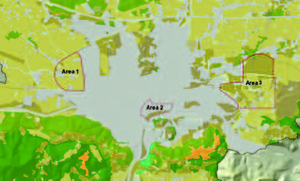
Location of the three pilot sites in Celje
Situation of the test area
Since the last change of the municipal master and land use plan the majority of the area has been dedicated to agricultural use and expansion of housing area, especially on its west side, where there is a neighbouring chemical company. Previous soil contamination samples have shown higher concentration of heavy metals, especially cadmium, which defines this area as a contaminated site and demands carefully chosen future land use with good
redevelopment management of the area.
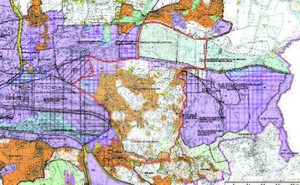
Land use plan of test area and surrounding (orange: housing area; white: agricultural use; violet: industrial, commercial use)
URBAN SMS activities
The main focus was given to improving the management of degraded urban areas. In the assessment of selected soil evaluation tools (based on the software tools Soil Contamination and Ecosystem Soil Quality) we have upgraded existing soil data with their spatial component. On the basis of these results the current land use plan and spatial trends were assessed.
Results and experiences
Soils on this area represent medium to high quality in terms of their natural functions, but with heavy metal pollution. Therefore, the soils are not appropriate for agricultural use. Consequently, changing the land use into an industrial or residential area is the only fitting solution, after thorough
remediation of the site to reduce the contamination related risk. The tool evaluation results are useful for an optimized spatial positioning of appropriate land use. This could minimize land take on areas with soils of high quality, suitable for food production or other sensitive land use and lead
towards more sustainable spatial planning.
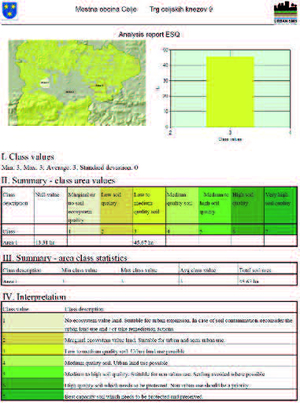
A result of ESQ tool assessment (Ecosystem soil quality)
COBRAMAN – Railway station in Kranj (SI)
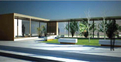
Pilot project scope
In the past 20 years liberal government policies and the booming property development sector, shifted most development into the hands of the private sector. Brownfield regeneration in Central Europe was all about transforming degraded areas mostly into shopping malls or private housing.
About the site
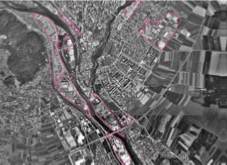
Kranj is the capital city of the Gorenjska region. It has almost fifty five thousand inhabitants (June 2011) and is the third largest city in Slovenia. At the end of the 19th century it became the most important industrial city in the Gorenjska region, with the production plants mainly situated near the Sava River. Cheaper production and labour force costs in other countries affected the city and triggered the issue of degraded areas. The area of nine hectares of land around the main Railway station was chosen as the pilot site, due to the mixed public and private ownership and location close to the city centre and Sava River.
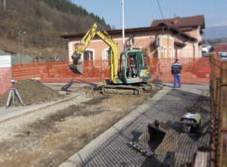
Activities during the project
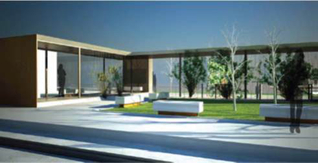
In 2008 the Municipality adopted its sustainable development strategy where brownfields regeneration became one of the main objectives of future development. In 2009 the Municipality prepared a vision to transform the railway station area into a passenger and business centre. Main efforts were focused on attracting public and private investors with adequate development plans. Redevelopment of the railway station area was also integrated in the Municipal Strategic spatial plan. The planning process included change of land use and identification of potential programmes for the area. The planning process continued with the preparation of expert guidelines for the Detailed Municipal spatial plan. Additionally, an innovative informal spatial planning document was prepared as a tool for easier negotiation between the City and potential investors during the regeneration process. An important step forward was the placement of the Information point inside the pilot area. The information point will promote brownfield redevelopment of the area to potential investors and the general public. It is also a start-up project, which shows the municipality’s interest in brownfield regeneration. Its design was obtained through a students’ competition at the Faculty of architecture of Ljubljana.
What have we learned?
The Site review proved to be a useful document/tool in the process of urban regeneration. It was used to collect information from different databases, personal input from various municipal departments, expert studies and other important sources. The main advantage was that it represented the state-of-the-art of the pilot area. The information from the Site review was an interesting source of information for the Mayor, Municipal departments, city council members, potential investors and different media. Using the Site review as a tool in the regeneration process was also be helpful as a management tool, but also as a communication and marketing tool. The municipality decided to use this tool in other urban regeneration processes in the future as well.
BICY – Bike sharing system in Velenje (SI)
Background
In Slovenia such bike sharing systems did not exist until 2011. At that time the first small scale modular system was implemented in the capital city Ljubljana. As for Velenje, that is a much smaller city, all the studies were taken from existing schemes in EU area by implementing the best case examples existing in EU and even broader (e.g., Italy, Austria, also Barcelona, Paris, Chicago student bike rental scheme…). This sharing system provides innovative technology solutions for rental services and a detailed concept of solutions for tracking and control.
Implementation
This bike sharing system provides safe and convenient access to bicycles for short trips within the city of Velenje. The international community experienced nearly 40 years with different bike sharing programmes. Until recently, bike sharing programmes worldwide have experienced low to moderate success. In the last 5 years, innovations in technology have given rise to a new (third) generation of technology-driven bike sharing programmes. These prorammes can dramatically increase the visibility of cycling and lower barriers to use by requiring only that the user have a desire to bike and a credit card or phone.
Existing and proposed bike sharing programmes employ a wide variety of technologies, and “lessons learned” are being continually applied to new systems. To be successfully implemented, it is important that the correct technology and package of services involved be mated to the unique challenges that each program faces.
For this reason it is strongly recommended that we consider starting the implementation with an independent assessment of Velenje needs, economics, technologies, logistical issues, service area, and other challenges faced by a final system.
Activities
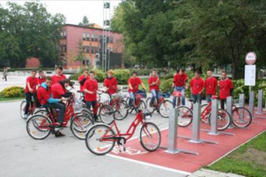
The project foreseen placement of 5 bike sharing point in the city of Velenje where on each would be 5 public bikes on for rental. Furthermore, it would provide innovative technology solutions for rental services and also detailed concept of tracking and control solutions.
This bike sharing system in Velenje allows leaving a bike on other points and by that serve as a useful city tool for many opportunities. The system will be upgraded accordingly to the findings and needs in the future. The investment in Velenje will consist in the Implementation of small scale bike rental scheme (5 rental stations, 25 bikes), based on a modular design of station that allows future adaptation, easy maintenance and possibility of movement in case of changes in the network.
Each station will be connected to central control station. Each rental point will be equipped with RFID reader and numeric keyboard. The local inhabitants are the target group of this new service. All needed activities and basis for placement (in duly time, namely in September 2012) of the planned bike sharing system have been done.
On following map you can see the eight location points of “BIKE SHARING SYSTEM”: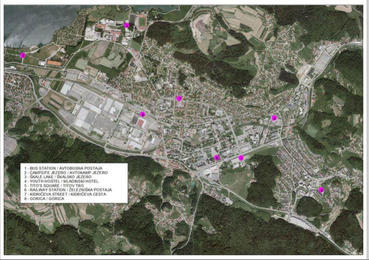
In the first line the system will be used by local inhabitants, including students, elderly inhabitants, families, individuals, sportsmen… generally citizens of Velenje and neighbouring areas-general public.
Results
- Equipment and Systems Bike Fleet
Fleet bikes are designed for easy city use and be clearly branded to increase general visibility. Bikes typically come with full fenders, chain guards and, in some cases, bike locks. Most bikes are equipped with a Global Position System (GPS) unit, Radio Frequency Identification (RFID) tag, or other type of tracking mechanism. This function is typically used in fleet management and location of lost or stolen bikes.
- Parking and Locking Mechanisms
Two major types of locking technology, both fully automated, are available:
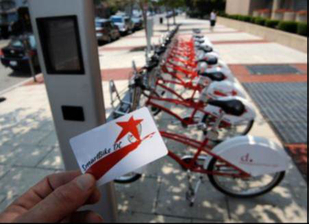
1. Bikes lock to either a rack or kiosk where users collect and drop bikes using a credit card or other card with a magnetic strip. This is commonly referred to as a smart card system. Smart card systems are found throughout the world. These systems are generally simple to operate, making them accessible to the general public.
2. Bikes are secured using an electronic lock mounted on the bike. Users must phone the operating company to receive the code to the lock. This is commonly referred to as a dial-a-bike, or call-a-bike
system. These systems are found predominately in Germany. Call-a-bike check-out requires very little infrastructure as the necessary mechanisms are mounted on the bike itself. Stations using smart card systems generally require:
• A bar, post or other physical structure to lock bicycles between uses
• A computerized system to check bicycles in and out
• A power source to control check-in/check-out and track bicycles
- Station Design, User Interface and Check-in/Check-out protocols
All bike sharing programmes require a user interface to col¬lect and retrieve bicycles, through a check-in/check-out system. The interface should be simple and easy to understand. Stations should provide clear directions on how to access and return a bicycle. Other recommended elements and design guidelines include:
• Instructions on where and how to return bicycles
• Cost and pricing information
• Contact information to report damaged bikes
or stations
• Maps of nearby stations and recommended
bicycle routes
• Damage resistant locking mechanisms
• Quick access to avoid queues and maximize safety
Costs & Funding
Station maintenance may include repairing lock mechanisms, replacing damaged interfaces, and installing new power sources. Bikes and stations not kept in good repair can create safety and liability issues.
Costs associated with a this system are diveded into four categories:
• Direct capital costs (e.g., bikes and terminals)
• Direct operating costs (e.g., administration, maintenance, and electricity to power terminals)
• Associated capital costs (e.g., construction of the system for building the necessary
infrastructure and streetscape improvements)
• Associated operating costs (e.g., maintenance of docking infrastructure and the existing bikeway network, insurance costs)
Funding for public bicycle systems commonly comes through a combination of advertisements, user fees, and public government funds and operates as a public-private partnership.
KASSETTS – “Broker Software” collaboration of Slovenia – Czech republic – Poland

Description
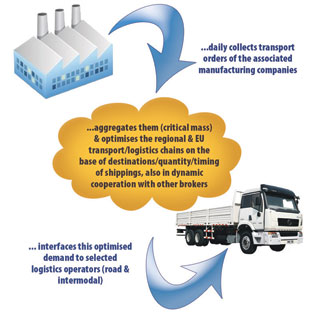
The finalised KASSETTS Broker network is the final result of this project. The network has been built step-by-step, by establishing and then linking the single broker nods into an operational framework. There were several pilot actions for testing this software in certain areas. Following pilot action covers the 3 states of Slovenia, Czech Republic and Poland.
Implementation
1. Data Collecting
– Slovenia:
The user companies involved in the pilots had the possibility to directly insert their transport data into the KASSETTS software or send transport data in different formats to the broker. In the next steps, data was transformed into Excel import files using pivot tables and other Excel functionalities to minimize manual work and to avoid errors or duplication of inserted data. Most of the data could be inserted into the KASSETTS software automatically (localities, sites, requests, etc.), some information had to be added manually (packages, etc.).
– Czech Republic:
In the Czech Republic, Excel KASSETTS format import files were used. For simplification of the whole procedure of the inserting of localities, sites and transport orders, a Czech version of templates was prepared. Below is a print screen of the Czech template. Czech companies were trained to fill in the tables during the pilot launching event and had no troubles to get used to them for creating transport requests. Brokers were in daily contact with both user companies and transport logistic operators. User companies were sending their transport orders to brokers mainly through e-mails.
– Poland:
Like in Slovenia and the Czech Republic, also in Poland the necessary available data was inserted to the broker software.
2. Key performance indicators
A list of Key Performance Indicators (KPI) has been created in order to evaluate the success of the pilots and the success of the whole project. KPI reports are simple tables that are automatically generated by the KASSETTS software. They cover a range of indicators that are used to monitor the successfulness of planning and evaluate the actual benefits of the system. The KPI reporting functionality was originally created to produce weekly reports on broker work. Periodical reports with indicators are generated automatically through the BROKER tool and allow each partner to automatically obtain an assessment of the quality of generated solutions in a given time frame. Reports summarize the work of a broker and all other involved parties (logistics operators, manufacturing companies) and are based on set of orders, a fleet of vehicles and computed missions by the broker. The KPI report compares the KASSETTS (fully consolidated) solution to the so called “BEST NULL” scenario, which assumes that: Companies order transport services directly at transport operator, without knowing the demand of other customer companies. Transport operators use the smallest vehicle available to transport the given order.
Within the so-called "KASSETTS scenario" the KASSETTS tool calculates and optimizes the best solution for the inserted transport orders with the aim to aggregate orders from different companies and thus contribute to a best solution for all involved companies and therefore lower their expenses.
Within the BEST NULL scenario the KASSETTS tool calculates and optimizes the best solution for the inserted transport orders and aggregate orders within each company (e.g. each company can aggregate their transport requests, but cannot aggregate with goods of other companies).
Whereas general indicators are overall indicators that provide a general outlook over the work of the broker node:
- Total number of orders (1) – Total number of all inserted and successfully calculated transport orders for the selected time frame.
- Total weight transported (2) – Total weight of transported cargo of all inserted and successfully calculated transport orders for the selected time frame.
- Percentage of international orders (3) – Percentage of international orders for the selected time frame.
- Percentage of regional orders (4) – Percentage of regional orders for the selected time frame.
Results
In order to understand the complexity of the software and work of the broker, different examples of regional and international transport missions are given for all participating regions. They are appropriately commented. For each broker/country two successful missions were selected – one national and one international mission. The missions are quantitatively and visually presented.
– Slovenia:
The results from Slovenia are satifying in all aspects. Altogether, 203 orders have been aggregated on 81 missions, 34 less than in the NULL scenario. Approximately 37 % of the orders were international while 63 % were national orders. Aggregation (consolidation) of transport orders was very successful, since 23,46 % of all missions had orders from more than one company on board of the vehicle. In this way, the broker has managed to lower the number of missions by 30% from 115 to 81, which also means fewer vehicles need to be engaged in the transport processes. One cannot say exactly how many vehicles less would be needed, since one vehicle may perform more missions in a given time period. The following positive effects need to be underlined:
– reduction of total length of driven routes by 21%;
– reduction of transport costs by 17 %;
– reduction of fuel consumption by 14% (over 4.700 litres less fuel used).
In addition, empty running has been reduced, as well as total time on road. The results of the Slovenian pilot may be evaluated as very successful. The success is at least partially due to the high number of orders during the chosen week.
– Czech Republic:
The Czech case differs a bit from the Slovenian because it had a lower number of orders (90), many of them international and hence more dispersed. This is why the results are not as good as in the case of Slovenia, but still are satisfactory, with e.g. cost savings of 6 %. The KPI report indicates that with the aid of the developed software, the Czech broker has managed to:
– reduce the number of missions by 22%;
– reduce the total length of driven routes by 6%;
– save 6% of transport costs;
– lower fuel consumption by 9% (app. 1.800 litres less fuel used).
The achieved savings amounted to approximately 190 thousand CZK or approximately 7.370 €. This would be the main motivation for broker operation. Also, fuel consumption was reduced which led to lower CO2 emissions and a reduced carbon footprint. The length of routes was shortened due to better planning. Besides these positive impacts, there were also negative impacts in total time spent in traffic. This seems to be the result of co-loading of entire vehicles, which have to wait in various loading and unloading sites. Also, the share of empty km was slightly higher in the case of KASSETTS solutions. However, these effects are overcome by cost savings and CO2 emissions reductions.
– Poland:
The Polish case also had less transport orders than the Slovenian, but more than enough to demonstrate savings in all aspects. Out of 109 orders, approximately 57 % were international and 43 % were national orders. The KPI report demonstrates that the Polish broker has managed to:
– lower the number of missions by 23%;
– lower the total length of driven routes by 8%;
– save 11% of transport costs;
– lower fuel consumption by 7% (over 757 litres less fuel used).
The total savings amount to 5.590 PLN, which is approximately 1.240 EUR. As in the Slovenian case, both empty running and total time on road have also been reduced. Approximately 18,18 % of transport orders have featured orders from more than one company. Provided the orders of companies would be more compatible in terms of time windows and locations, this percentage could also be increased, which would also greatly boost total savings.
Main Results
The main results of the broker efforts have been the following:
– 26,29% less transport missions.
– 14,28% less kilometres driven by vehicles.
– 9,04% less fuel used.
– 10,9% lower costs for involved manufacturing companies.
Additionally, CO2 emissions have been reduced by 11,50 %, which amounts to 19,24 tonnes. The share of empty kilometres and total time on road have also been decreased significantly, which all indicates that the overall results of the pilots can be evaluated as very successful, also from an environmental perspective.
ReNewTown – Revitalisation of public space in Velenje (SI)
Background
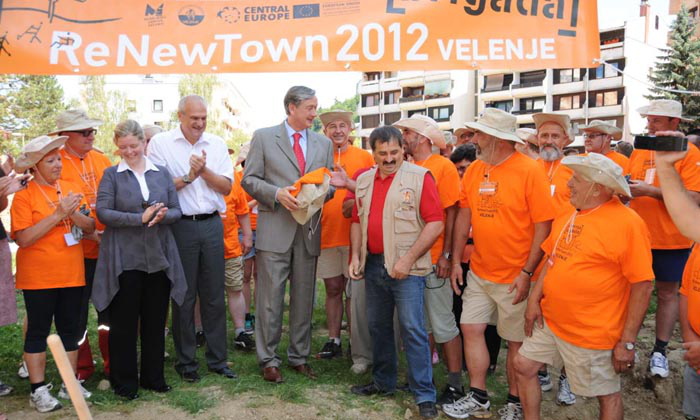
Historically, the city of Velenje has faced intensive urbanisation in the 1950s due to the coal-mining boom, when the new housing for about 20.000 inhabitants was built. The socialist era housing facilities characterized by lack of green area and poor maintenance of the public spaces became the earmark of the city. The basic concept of the ReNewTown pilot activity tested in Velenje was to involve inhabitants in the revitalization process of local public space that included voluntary work having strong roots in the socialist period of the city development.
Activities
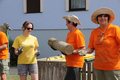
Firstly, a survey mapping the willingness of the inhabitants to participate as volunteers in the revitalization process was conveyed. More than 70 % of the respondents were willing to voluntarily assist in the implementation of the pilot action. 64 volunteers (local residents) finally met in summer 2012 in order to build a local public space suited for all generations represented in the local area, investing 1.567 hours of their voluntarily work. The total sum of the investment (material) was supported by the ERDF by 38.500,- EUR.
Results
The opening ceremony was attended by the president of Slovenia, Danilo Türk. The event attracted the interest of both local and national media. The president highlighted the importance of intergenerational solidarity at different levels, including housing estates, which gives citizens hope for their present and future well-being. He stressed that Slovenia has a good tradition of solidarity, which includes the enthusiasm experienced after the Second World War. Velenje has become and still remains a symbol of solidarity and a strong will to build a future together. The help of volunteers in the implementation of the ReNewTown pilot project in Velenje continued the spirit of volunteering and presented it to Slovenia and Europe as an example of good practice.
More information about the project and its pilot activities is available on project website. The Slovenian project partner published a video documenting the activity that is available here (in Slovenian language only).