
REGIONAL INFORMATION:
Oberösterreich / Austria
Area: 11.982 km²
GDP (PPS per inhabitant): 28.700
GDP Index EU 27: 121,3
Metal production, Machinery, Chemical and food-processing industry, Clusters, Construction industry, Financial services, Mechanical sector

If you are not yet a member you can register here.
| ACCESS | ACCelerating regional competitivenESS and sector-based excellence through innovation management tools and techniques | |
 |
Regional partner(s): | |
| INTRAMED-C2C | Innovation transfer in the medical sector from clinics to companies | |
 |
Regional partner(s): | |
| CLUSTERS-CORD | Clusters & Cooperation for Regional Development in Central Europe | |
 |
Regional partner(s): |
|
| CNCB | Cluster and Network Cooperation for Business Success in Central Europe | |
 |
Regional partner(s): | |
| SMART FRAME | Smart Framework for SME´s focused on Modern Industrial Technologies | |
 |
Regional partner(s): | |

| ChemLog | Chemical Logistics Cooperation in Central and Eastern Europe | |
 |
Regional partner(s): | |
| FLAVIA | Freight and Logistics Advancement in Central Europe – Validation of processes, Improvements, Application of co-operation | |
 |
Regional partner(s): | |
| ChemLog-T&T; | Tracking and Tracing solutions for improvement of intermodal transport of dangerous goods in CEE | |
 |
Regional partner(s): |
|
| REZIPE | Renewable Energies for Zero Emission Transport In Europe | |
 |
Regional partner(s): |
|

REZIPE – Boosting e-mobility in Upper Austria

Description
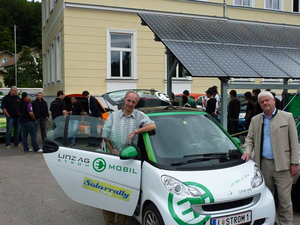
The photovoltaic charging station (3 kWp) was installed in Upper Austria, where three important partners of the Upper Austrian administrations were brought together and successfully implemented the pilot activity.
- The Environment Department financed the facility and co-ordinated the network and public relation-activities. The installation was involved as a highlight during the Solar Rallies 2010, 2011 and 2012, also in regional and local (city of Attnang-Puchheim) events and activities.
- The Department for Public Buildings and Procurement was in charge of leading the tendering process.
- The employees and pupils of the vocational school are the main users of the facility. In addition the vocational school got an e-bike for business trips of their employees (financed by the Environment Department; not included in the project budget).
The electricity produced is free of charge for all employees driving to the office by e-bikes and e-scooters.
The Solar Rallies were initiated by the Environment Department of Upper Austria and organised by "Climate Alliance Upper Austria". The event took place in years 2010-2012 with a great success.
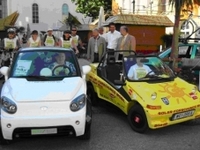
In 2010, the rally was embedded in the Austrian Climate Tour that involved several municipalities organising local events. In 2011, e-cars and e-bikes went separate tours, but a joint arrival at the municipalities which organised programmes for public were guaranteed. In 2012, a perfect fleet of 12 e-cars was presented and tested by interested public.
Main objectives
- Demonstration of a future oriented solution of a bicycle charging facility
- Increase of public awareness for e-mobility
- Build a basis for future charging site for e-cars
Financials
The 3 kWp photovoltaic charging station (22.000 Euro) and the Solar Rallies (app. 20.000 Euro per Rally) are financed by the Environment Department of Upper Austria, co-financed by the EU in the program Central Europe (within the REZIPE project).
Outcomes & Results
One 3 kWp photovoltaic charging station: The green electricity produced will be 3000 kWh annually, used by e-bikes and e-scooters of the administration and employees and during the three Solar Rallys. This action will lead to a reduction of CO2-emissions by one tonne per year.
Solar Rally: Involvement of most actors focusing on e-mobility in the region. Therefore a basis for networking shall be established. Involvement of at least five municipalities per Rally. Invitation and participation of several hundred citizens and pupils.
ChemLog – Evaluation of Danube axis as multimodal transportation corridor for chemical industry, Upper Austria (AT)
Description
In many regions, especially in Eastern Europe, road traffic has reached its capacity limits. Further deficits are a barrier to the development of the chemical clusters: Capacities and the expansion of transport infrastructure are not sufficiently oriented towards the needs.
The use of roads and railways together with the development of pipeline systems for the connection of raw material locations and production locations all play an important role in this context. As a result of historic decisions the important chemical locations in Poland, the Czech Republic, Slovakia, Austria, Hungary, Novara (IT) and East Germany are sites with no direct access to sea ports.
Therefore, these locations have competitive disadvantages, especially in relation to the higher costs compared to chemical locations in Western Europe that have excellent access to sea ports and connected waterways. The existing cost disadvantages resulting from the traditional location and missing West‐East connections are an important development barrier for the Chemical Industry in CEE. These competitive disadvantages are further enhanced by the disproportionate high usage of road transport, whereas railway and inland waterway transport still have unexhausted capacities.
Objectives
- Strengthen territorial cohesion in Central Europe by developing a Central and Eastern European Chemical Logistics Network as a platform for the joint discussion and cooperation for chemistry related transport issues
- Promote the internal integration by improving chemical logistics in Central Europe
- Strengthen the competitiveness of the chemical cluster in better connecting raw material and production locations and better accessing the growth markets in CE Europe
- Strengthening rail and waterway transport for chemical goods in comparison to road in order to improve safety and environmental protection, to reduce costs and increase speed and flexibility of chemical logistics
- Support the development of logistic centres for intermodal transport and their integration in infrastructure planning
- Facilitate the connection of pipelines for an effective Central and Eastern European Chemical Logistics Network
- Initiate transnational know‐how and technology transfer for the development of transport and guidance systems focused in the West‐East direction
- Supporting the realisation of Trans‐European Traffic routs and harmonisation of regulations and coordinated planning of infrastructure and the use of Structural Funds
Activity: Feasibility Study
Generally, the ChemLog feasibility studies focus on transnational infrastructure projects in the area of railway transport, intermodal transport, waterway and pipeline transport. It should be used to assess the feasibility of selected infrastructure projects with high potential for the Chemical Industry and contain detailed conclusions for the realisation of this infrastructure in view of investment preparation.
The Logistikum.research put the focus of the feasibility study on strengthening the Danube waterway for the chemical industry. The first two chapters deal with information about the project ChemLog, the feasibility study in general as well as about the chemical industry in Austria. Further on facts on the Danube corridor VII are presented and topics about the European transport policy are analysed. The Austrian part of the Danube corridor is the main topic.
The feasibility study highlights the infrastructural bottlenecks of the inland waterway itself and of important Danube ports and terminals. These topics as well as possibilities to evaluate logistic nodes regarding their appropriateness for the chemical goods transport were discussed within the 3. ChemLog Expert Dialogue. The factors of the evaluation scheme to assess the logistic nodes were identified within expert workshops and interviews.
Please click HERE (1,53 MB) to download the feasibility study for Austria.
Results
This pilot action promotes the internal integration in Central Europe by improving chemical logistics. The countries of Central Europe are especially disadvantaged due to existing barriers and missing connections alongside the former border between Eastern and Western Europe. The project works on the further development of the Transeuropean Transport Networks with specific focus on the transnational projects in the partner countries. It strengthens the competitiveness of the Chemical Industry within Central Europe, which is a major economic industry with strong impact on innovation and employment in the partner countries. Furthermore the Chemical Industry has a strong influence on many other industries alongside the value‐chain. A better connection between the chemical locations is a precondition for the sustainable development of the industry in the long‐run, especially taking into account the increased competition from Asia and the Far East. The know‐how and technology transfer increases the innovation capacity of the partner regions in the area of chemical logistics.