
REGIONAL INFORMATION:
Zapadne Slovensko / Slovakia
Area: 14.993 km²
GDP (PPS per inhabitant): 14.800
GDP Index EU 27: 62,8
Agriculture, Engineering, Logistic sector, Food processing, Automotive, Electrical processing
Trnava region
Nitra region
Trencin region
If you are not yet a member you can register here.
| CENTROPE_TT | Tools for Transnational Innovation Support in Centrope | |
 |
Regional partner(s): |
|
| AutoNet | Transnational Network of Leading Automotive Regions in CE | |
 |
Regional partner(s): |
|
| CLUSTERS-CORD | Clusters & Cooperation for Regional Development in Central Europe | |
 |
Regional partner(s): |
|
| CluStrat | Boosting innovation through new cluster concepts in support of emerging issues and cross-sectoral themes | |
 |
Regional partner(s): |
|
| i.e.SMART | SMART Training Network for Innovation and Entrepreneurship in Emerging Sustainable Economic Sectors | |
 |
Regional partner(s): |
|
| SALVERE | Semi-natural grassland as a source of biodiversity improvement | |
 |
Regional partner(s): |
|
| CEP-REC | Introduction of Regional Energy Concepts | |
 |
Regional partner(s): | |

| CENTROPE CAPACITY | Sustainable urban and regional cooperation for a polycentric territorial development in a competitive CENTROPE region | |
 |
Regional partner(s): | |
| CIRCUSE | Circular flow land use management | |
 |
Regional partner(s): | |
| CENTRAL MARKETS | Revitalising and promoting traditional markets in central Europe | |
 |
Regional partner(s): |
|
INCA-CE – Hydrology actions in Slovakia
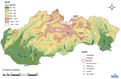
Department of Hydrological Forecasts and Warnings is responsible for hydrological part of work on INCA – CE project in structure of PP2 (Slovak Hydrometeorological Institute – SHMI). This department is a part of Centre of Forecasts and Warnings.Department of Hydrological Forecasts and Warnings is producing numeric forecasts for 3 main Slovak rivers (Danube Morava (March) and Bodrog River). We are also producing inflows into the large dams localized on many rivers.
All informations are based on datas from watergauge stations. In this time more than 260 stations (accurate number is changing from day to day) is situated on the area of Slovakia. On every station waterstage, water and air temperature is measured. Some of them are able to measure precipitation amounts too. All datas from these stations are online and available all the time.
Second aim is creation and dissemination of hydrological warnings. For common population are hydrological warnings publishing on internet (www.shmu.sk). For special users (Civil Protection, Slovak Water Management Company, local authorities responsible for flood protection and ministry of environment) special form of warnings are send by email. Since july new system of hydrological warnings based on counties will be in operation. (see pic. 1. before).
Characteristics of the pilot area
Not only one single pilot area have been chosen., but 5 independent areas with different natural conditions in various parts of Slovakia. In every pilot basin flash flood has occured in previous 20 years. In every pilot basin raingauge and watergauge station must be localized.
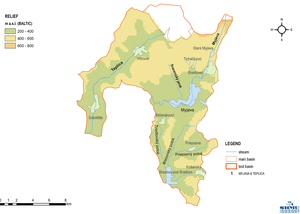
Myjava river basin is localized in western part of Slovakia. Myjava is a tributary of Morava (March) river. Many flash floods has occured there. In 2009 2 people died after flooding on small Myjava rivers tributary. In this pilot area many studies has been done before. In this watershed 6 watergauge stations is localized so we can work as well with main river (Myjava) as with tributaries (Svacenicky jarok, Brezovsky potok, Brestovecky potok, Teplica).
Area of Myjava river basin is 27 km2 and its tributary Teplica 86km2 . Both watersheds are created by flysch stone which should be very auspicious for flash flood creation. In this area big deforrestations has been done in last century. That is the reason, why the outflow creation time is only about 6 hours. As a flash flood protection many small dams and polders has been builded in this river basin to protect main habitations. That is the reason why the worst floods aren´t occuring on main river, but on small tributaries.
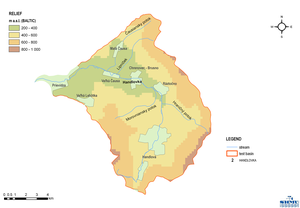
Second pilot area is Handlovka river basin. In this watershed very important flash flood has occured in 2010. Return period of this flood was identified as more than 1 000 years. This flash flood caused damages in big parts of Handlová and Prievidza cities. In this watershed flash floods have occured very often. In 1990 – 2010 time period 16 flood waves produced by torrential rain has been recorded.
This river basin is situated in central part of Slovakia in Nitra river basin. In this river basin 1 raingauge station and 2 watergauge station are situated. Its area is 133 km2. Its geology is a little bit complicated but important part of river basin is created by paleogenic flysch. Higher parts of watershed are builded by various vulcanic rocks and sediments. In this case concentration time of flood wave is very short. In many waves time from the beginning of flood wave till peak point was shorter than 1 hour. Average concentration time is longer – 4 hours.
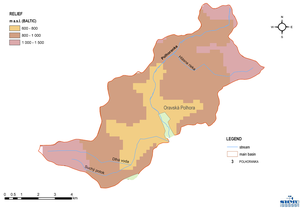
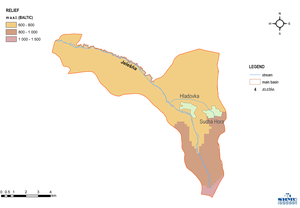
There are two pilot areas in the Northern part of Slovakia in Orava river basin. Both of these rivers are tributaries of Orava river. Jelešňa and Polhoranka rivers basin was chosen because of serie of flash flood which have occured there in 2009 and 2010. In both river basins are one watergauge and one raingauge station situated. Jelešňa river basins area is 48 km2 . Polhoranka river basins area is 59 km2 . Natural conditions in both areas are very similar. Both are created by flysch stones and major watersheds landcover is forrest. Both watersheds average elevation is almost 1 000 m a.s.l. Although Jelešňa river basin is smaller, concentration time is longer – more than 5 hours. In Polhoranka river basin the concentration time is 3 hours.
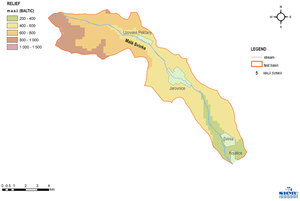
Fifth pilot river basin is situated in the eastern part of Slovakia. Mala Svinka is part of Hornad river basin. In Mala Svinka river basin isn´t waterstage station so we must to work with datas from waterstage from the Svinka river basin. Its watersheds area is 320 km2. Svinka river basin is created mainly by paleogenic flysch. Concentration time is 4 and half hour. In Mala Svinka river basin devastated flah flood has occured in 1998 with more than 50 victims. That was the main reason, with this watershed was chosen as pilot area.
Users/stakeholders in the pilot region
Hydrologic outputs of INCA – CE project are dedicated to protect the population against the possibility of flood caused by rain with very short duration. SHMI (PP2) isn´t able to make real flood protection. Our main aim is to inform responsible institution about the possibility of flood. In this way, these responsible institutions become our stakeholders.Here is the list of main stakeholders:
1. Civil protection
2. Slovak Water Management Company
3. ministry of environment
4. local administration
Civil protection is responsible for protect life, health and prophety of public against disasters including floods. Second responsible institution is Slovak Water Management Company, which is responsible for taking care of water stream and for protecting public in the case of flood. Third institution responsible for flood protection is local administration which should take care in the case of very local events. Ministry of environment is receiver of our hydrological warning and should coordinate actions of its subordinated organizations.
All these institution are informed about possibility of flood in the form of hydrological warning, which are sending to them by email and is publishing on the web site of institute too. After receiving of hydrological warning they are responsible for providing decision which should protect public against the flood danger. In present this warning is not working on nowcasting products, but is based on outputs from meteorological models or on consideration of actual meteorological situation.
With exception of local administration there was no need of special contacting and informing about INCA – CE project. CP in Slovakia is independent partner of INCA – CE project. We need to contact only the local administration in the pilot areas. The cooperation is in the form of direct warning of local administration in pilot areas in the case of predicted flood. The aim of local administration is validation of model results in the case of flash flood on water streams without watergauge stations.
CERREC – Mobile collection of electrical and electronic waste equipment in Senec
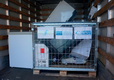
After promotion through information leaflets and through advertisement in local newspapers, we collected approx. 2,36 tons of Waste Electrical and Electronic Equipment (WEEE) and 0,84 tons of non-WEEE (EEE). Collective Schemes ENVIDOM performed sorting of collected WEEE to directly reusable goods, non-reusable WEEE or for reusable goods after repair.
Results and numbers: after revision of 50 pcs of good condition EEE were suitable for direct donation 5 pcs, for donation after repair 6 pcs (costs for repair amounted to 150 Eur) and 39 pcs were not suitable for donation. In total
10% of collected goods were donated to charity.
CEC5 – Demonstration building: Secondary technical school in Senica

Regarding the education, SOS Senica has been successfully participating in the ENERSOL competition for several years – this is competition for secondary schools students in the field of RES innovative approaches.
SCHOOL SENICA, SLOVAKIA
Work started with preparation of a public procurement for the overall DB refurbishment including: elaboration of technical realisation documentation; obtaining all necessary permits, including construction permit; implementation of the DB refurbishment itself. Simultaneously, a separate public procurement for construction inspection was carried out.
The timeplan is as follows:
6/2013: the public procurement („over-limit order) launched;
7/2013: offers submitted;
8/2013: the public procurement evaluated and a winning competitor identified;
10/2013: the Slovak FLC concludes the tender documentation control;
11/2013: a contract signature and start of the DB refurbishment
4/2014: DB refurbishment completed.
Between 12/2013 – 8/2014: organised study visits and individual guided tours through the project partner (the DB will be accessible after the CEC5 project completion as well).
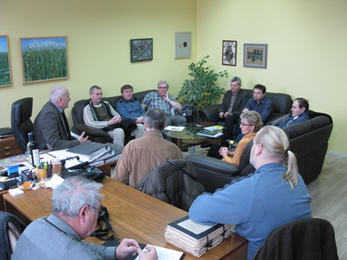
Within April 2012 – February 2013 several meetings took place in the Senica school with participation of PP14, Director and Financial Manager of the Senica school as well as with representatives of potential service providers. So far the last meeting took place on 6.2.2013 where Project Coordinator and Investment Manager of PP14 participated with Director of the Senica school and representatives of supplier for elaboration of documentation specifying technical standards for RES facilities to be installed at this school. Such documentation will be a basis for preparation of tender documentation for public procurement for supplier of the overall reconstruction of the Senica school pilot investment. PP14 intends to launch such public procurement in the mid of 2013 with aim to complete the demonstration building reconstruction in the end of 2013.
Referring to the CEC5 project, SOS Senica currently using natural gas for heat and warm water preparation, aims to install RES for this purpose: solar collector, biomass station using pellets and heat pump “air – water system”. The external walls as well as roof are going to be insulated and small demonstration room showing actual state of energy generation and consumption will be set up. This refurbishment was realised within the I. half of 2013.
Among others, through this demonstration activity as well as the overall CEC5 project, TTSK aims to draw attention to EE/RES issues on regional/local level and brings “Success story” to other schools, social facilities, etc. On broader social perspective, TTSK also intends to emphasize the fact that we must pay attention to energy efficiency in our lifes, including buildings, otherwise energy / environmental debt we may shift forward to future generations might become unprecedented.
CEP-REC – Results of energy analysis in Trnava (SK)

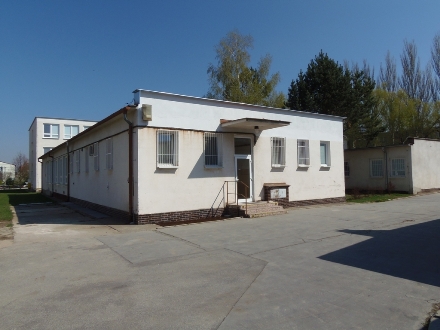
There is a large range of plants and capacities for electricity production. The most important energy sources in the region include the V2 Bohunice nuclear power plant, the Gab?íkovo hydro power plant and imported gas. Regional power plants utilize the hydro power potential of Vah and Danube rivers, which provide an inexhaustible energy resource. The next most important renewable resources are solar power, wind power, geothermal energy, biogas and biomass.
Contact:
Trnava Self-Governing Region
www.trnava-vuc.sk