REGIONAL INFORMATION:
Mazowieckie / Poland
Area: 35.558 km²
GDP (PPS per inhabitant): 19.700
GDP Index EU 27: 83,6
Science and technology, Research and Development, Chemical and Petrochemical industry, Banking sector, Electronics industry, Tourism, Steel industry, Engineering industry, Food processing industry
CENTRAL EUROPE Regional Contact Points:
OFFICE OF THE MARSHALL OF THE MAZOWIECKIE VOIVODESHIP
Jagiellońska 26,
03-719 Warszawa
Phone +48 +22 5979-100
Fax +48 22 5979-290
e-mail: urzad_marszalkowski(at)mazovia.pl
If you are not yet a member you can register here.
| CEBBIS | Central Europe Branch Based Innovation Support | |
 |
Regional partner(s): |
|
| FLAME | Future Laboratory for the Diffusion and Application of Innovation in Materials Science and Engineering | |
 |
Regional partner(s): | |
| NANOFORCE | Nanotechnology for Chemical Enterprises – how to link scientific knowledge to the business in the Central Europe space | |
 |
Regional partner(s): | |
| SMART FRAME | Smart Framework for SME´s focused on Modern Industrial Technologies | |
 |
Regional partner(s): | |
| PLASTiCE | Innovative value chain development for sustainable plastics in Central Europe | |
 |
Regional partner(s): | |
| CluStrat | Boosting innovation through new cluster concepts in support of emerging issues and cross-sectoral themes | |
 |
Regional partner(s): |
|
| ChemLog | Chemical Logistics Cooperation in Central and Eastern Europe | |
 |
Regional partner(s): | |
| GUTS | Green Urban Transport Systems | |
 |
Regional partner(s): | |
| SOL – Save Our Lives | SOL – Save Our Lives. A Comprehensive Road Safety Strategy for Central Europe | |
 |
Regional partner(s): | |
| INWAPO | Upgrading of Inland Waterway and Sea Ports | |
 |
Regional partner(s): |
|

| 4BIOMASS | Fostering the sustainable usage of renewable energy sources in Central Europe – putting biomass into action | |
 |
Regional partner(s): | |
| COACH BioEnergy | Strengthening the energetic use of biomass in Central and Eastern Europe by establishing a standardised transnational consulting net for regions | |
 |
Regional partner(s): | |
| INCA-CE | INCA Central Europe – Integrated nowcasting system for the Central European area | |
 |
Regional partner(s): | |
| EULAKES | European Lakes Under Environmental Stressors (Supporting lake governance to mitigate the impact of climate change) | |
 |
Regional partner(s): | |
| EnSURE | Energy Savings in Urban Quarters through Rehabilitation and New Ways of Energy Supply | |
 |
Regional partner(s): | |
| HABIT-CHANGE | Adaptive management of climate-induced changes of habitat diversity in protected areas | |
 |
Regional partner(s): | |
| INARMA | Integrated Approach to Flood Risk Management | |
 |
Regional partner(s): |
|
| UHI | Development and application of mitigation and adaptation strategies and measures for counteracting the global Urban Heat Islands phenomenon | |
 |
Regional partner(s): | |
| CoP | Cities on Power | |
 |
Regional partner(s): |
|
| CEP-REC | Introduction of Regional Energy Concepts | |
 |
Regional partner(s): |
|
| ECOPAPERLOOP | Eco design for the enhancement of central Europe paper based products recycling loop | |
 |
Regional partner(s): | |
| LiCEA | Life Cycle based Energy Audit | |
 |
Regional partner(s): |
|
| ReNewTown | New post-socialist city: Competitive and Attractive | |
 |
Regional partner(s): |
|
| airLED | airLED: Local economic development in airport catchment areas | |
 |
Regional partner(s): |
|
FOKS – Prevention of groundwater pollution in Jaworzno (PL)
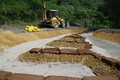
The town of Jaworzno lies in the southern part of Poland, in the eastern part of the Province of Silesia (the most industrialised area in Poland), at the place where the regions of Upper Silesia and Lesser Poland meet; at the crossing of some major national and international lines of road, railway and air communication. In respect of area Jaworzno is among the largest towns in Poland – its area is 152,59 km2 with more than 96 000 inhabitants. The town of Jaworzno is a member of the Metropolitan Association of Upper Silesia – the largest urban centre in this part of Europe.
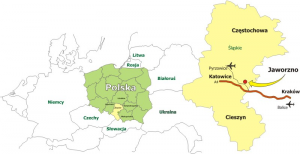
Map: Jaworzno against background of Poland
Jaworzno’s economy is based on power engineering connected with the extractive industry. Centuries of activities of the extractive industry (coal, dolomite and sand), power engineering, cement and chemical industry have affected far-reaching transformations of components of the environment. The most significant transformations affected surface water, including the composition of ecosystems, changes in the river network and its nature (infiltration/drainage), mining drainageand the appearing of post-mining settlers, adverse changes in water chemistry. Equally profound, but much more harmful are consequences of the anthropogenic impact on the state of resources and quality of groundwater as a potable water reservoir.
Environmental problem of Jaworzno
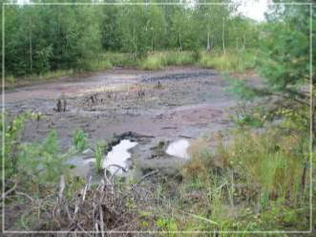
Jaworzno’s biggest problem is the impact of pollutants from the chemical industry in the valley of brook Wawolnica. The brook of Wawolnica is located in the south-western part of Jaworzno. Wawolnica passes through the territory of the Chemical Plant “ORGANIKA AZOT” SA, which was founded in 1917. Since this time there have been produced a lot of chemical substances and effectuated some synthesis. As from 1928 to eighties of the twentieth century, the valley of brook Wawolnica was the site of hazardous waste collection from production, e.g. plant protection products and preparations for hygiene. Irregularities in the way of waste collection has led to significant environmental pollution of soil and groundwater.
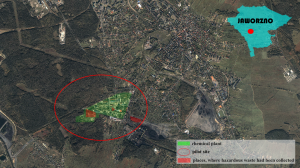
Map: pilot area against background of Jaworzno
Direct contact between pollutants and surface water cause cross-border pollution, which classify the Chemical Plant as an European hot-spot (one of seven especially severe sources of industrial pollution for the Baltic Sea), placed on the list of the Baltic Sea Joint Comprehensive Environmental Action Programme in the framework of the Helsinki Commission.
![The Chemical Plant in Jaworzno against background of Polish HOT-SPOTs [2009]](https://www.central2013.eu/files/uploads/rtemagicc_9a8dc0ae25.png.png "The Chemical Plant in Jaworzno against background of Polish HOT-SPOTs [2009]")
Map: The Chemical Plant in Jaworzno against background of Polish HOT-SPOTs [2009]
Within the valley of brook Wawolnica have being found out compounds that pose high risks to ecosystems and human health. There have been inventoried more than 195 000 tons of hazardous waste so far (including HCH, DDT/DDE/DDD, dieldrine, endrine, etoxychlorine, benzene) – however, this figure does not reflect the actual quantity of pollutants in the pilot site, which area has been initially estimated to be 0,5 km2. Up to now, some investigations have been done in this area didn’t show the whole picture of environmental impact of pollutants accumulated in the valley.
FOKS activities
In the framework of FOKS project, at the Polish pilot area are being implemented, among the others, field investigation on contaminated sites, including drillings, geophysical works, geological interpretation, pumping tests, soil and water sampling as well as passive sampling technology. In addition to traditional methods, it is also being planned to implement fingerprinting and backtracking – technical tool which allows to follow the back tracking paths of pollutants through pumping tests. Pilot remediation in Jaworzno includes the application of Permeable Reactive Barrier, Phytoremediation and Copper Mediated Destruction technology invented by Czech Partner.
These activities should help with comprehensive identification of environmental risk in Jaworzno’s pilot area and with selection of the most suitable technology to prevent problematical pollution – optimal in costs and outcomes. Implementation of innovative tools proposed in the FOKS project, in comparison to traditional methods, should significantly reduce the costs of identifying and evaluating risks of groundwater pollution.
CEP-REC – Results of energy analysis in Mazovia (PL)

It occupies 35 579 km2 of central-east Poland (11.4 % of Poland’s surface area) and has a population of 5.29 million (13.1 % of the population of Poland), of whom 64 % live in cities.
The Mazovia Region is one of the most dynamic in Poland and in Central-Eastern Europe. It is a crossroad of communication and trade, and a financial centre connecting the East and West of Europe. Warsaw, Poland’s capital and largest city, is located in Mazovia. Its population is around 1.8 Mio., and with adjacent towns totals 2.5 Mio. inhabitants. It is a hub for both road and rail traffic across Europe, and also a centre for telecommunications, finance and insurance. Around Warsaw are the four main regional towns Plock, Ostro??ka, Siedlce and Radom, which are interconnected by road and train.
Mazovia has by far the highest GDP in Poland. GDP per capita in Warsaw (2011) was three times higher than the national average.
Necessity for reducing gas emissions and carbon share in the energy sector
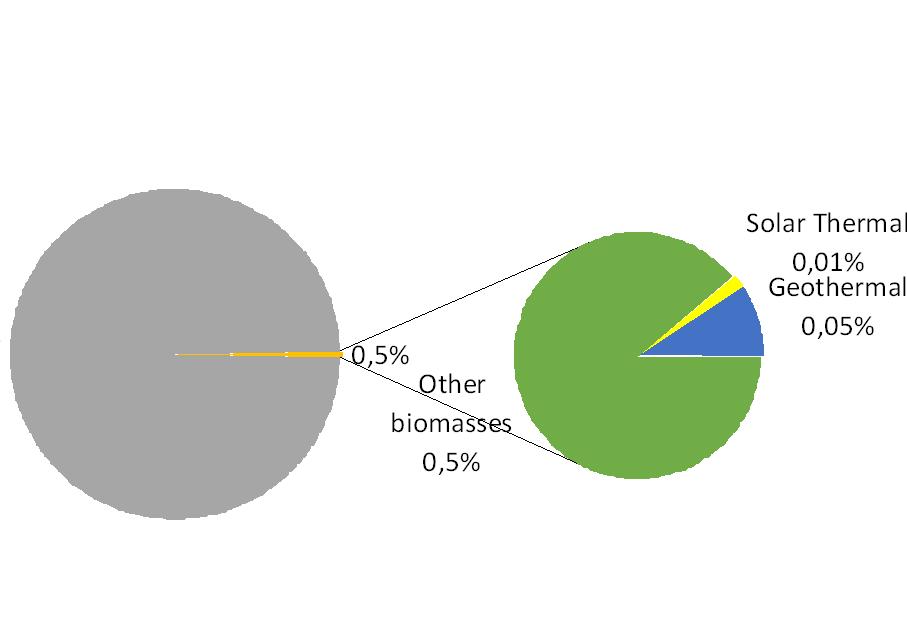
Heat production by renewable energies
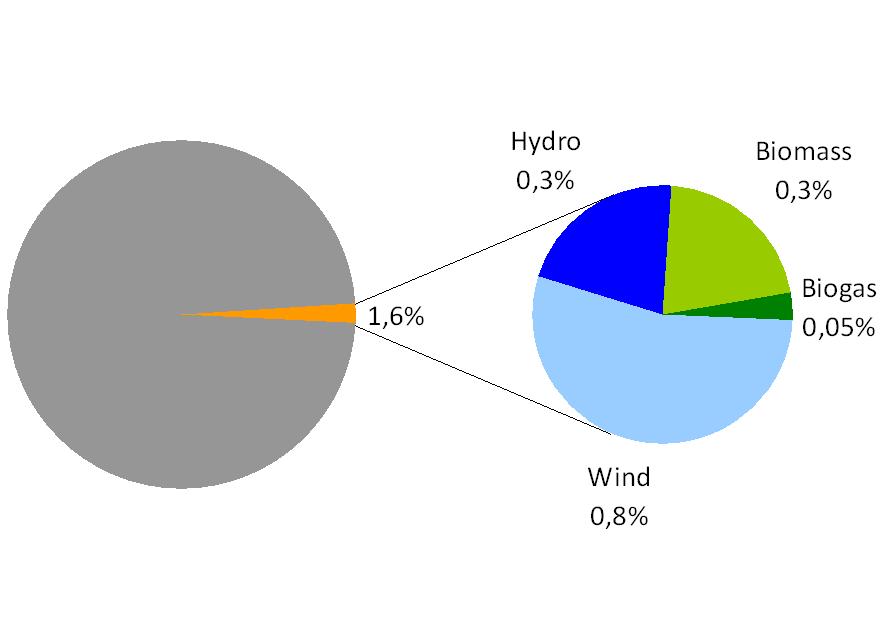
Electricity production by renewable energies
Although Mazovia is developing rapidly in economic terms, its share of RES usage is still lower than in other parts of the country. Energy investments in the past concentrated mostly on energy efficiency, almost enabling energy production and consumption to be balanced.
Due to the huge spatial, urban and economic diversity, as well as the quantity of agriculture in Eastern and Northern part of Mazovia Region, it is necessary to develop complex energy programmes to cater for particular branches and energy consumers.
These programmes should provide both the continuity of the energy efficiency activities and a reduction of gas emissions in economy, agriculture and households. They should also concentrate on diminishing the carbon share in the energy sector and on increasing RES applications.
Contact:
Mazowiecka Agencja Energetyczna Sp. z o.o.
www.mae.com.pl