
REGIONAL INFORMATION:
Malopolskie / Poland
Area: 15.190 km²
GDP (PPS per inhabitant): 10.700
GDP Index EU 27: 45,4
High technology industry, Banking sector, Chemical and Metallurgical industries, Coal and ore mining, Food processing industry, Tourism
http://www.malopolskie.pl/
CENTRAL EUROPE Regional Contact Points:e-mail: ewt(at)umwm.pl
Phone: +48 12 29 90 699
Fax: + 48 12 29 90 726
If you are not yet a member you can register here.
| INNOTRAIN IT | INNOvation TRAINing IT Central Europe | |
 |
Regional partner(s): | |
| INTRAMED-C2C | Innovation transfer in the medical sector from clinics to companies | |
 |
Regional partner(s): |
|

| 4BIOMASS | Fostering the sustainable usage of renewable energy sources in Central Europe – putting biomass into action | |
 |
Regional partner(s): | |
| VITAL LANDSCAPES | Valorisation and Sustainable Development of Cultural Landscapes using Innovative Participation and Visualisation Techniques | |
 |
Regional partner(s): |
|
| VIS NOVA | Sustainable and efficient Energy for Rural Regions | |
 |
Regional partner(s): |
|
| SECOND CHANCE | From Industrial Use to Creative Impulse | |
 |
Regional partner(s): |
|
| ReNewTown | New post-socialist city: Competitive and Attractive | |
 |
Regional partner(s): | |
| ADAPT2DC | New innovative solutions to adapt governance and management of public infrastructure and services to demographic change in shrinking regions and cities of CE | |
 |
Regional partner(s): |
|
| HERMAN | Management of Cultural Heritage in the Central Europe Area | |
 |
Regional partner(s): |
|
| THETRIS | THEmatic Transnational church Route development with the Involvement of local Society | |
 |
Regional partner(s): |
|
| CENTRAL MARKETS | Revitalising and promoting traditional markets in central Europe | |
 |
Regional partner(s): |
|
| airLED | airLED: Local economic development in airport catchment areas | |
 |
Regional partner(s): |
|
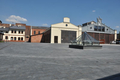
SECOND CHANCE – Open Spaces of Quarter St. Lawrence, Krakow (PL)
Description
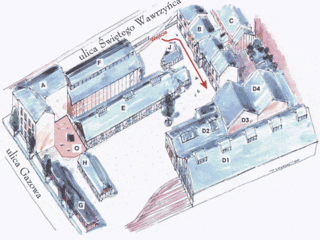
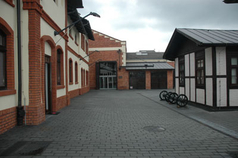
The headquarters of the Museum of Municipal Engineering is a heritage complex of tram depot in Krakow’s Kazimierz at the intersection of Gazowa and św. Wawrzyńca (st. Lawrence) Streets, built in stages from the end of the 19th to the beginning of the 20th century.
Activities
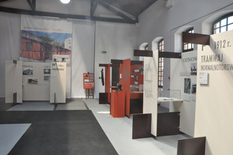
Since 1995 the Quarter of St. Lawrence is undergoing renovation and adaptation for the needs of the Museum of Municipal Engineering. The renovation of historical depot halls was completed in 2010. The renovation has been carried out with the original architectonics forms in mind and the greatest possible use of authentic materials, with an eye for their visibility and display.
Results
- Installation of street furniture on the square: benches and bike racks to attract new visitors
- Creation of visual identification of the site: information for visitors about post-industrial heritage – information boards and signboards, touch screens, audioguides
- Installation of facilities for open events: large screen, interactive installations, playground and space for mothers with children, tents to organize outdoor events
- Installation of facilities for meetings and events: exposure, projector;
- Small scale investment on the square – reconstruction and renovation of stone surface of place for outdoor events
ReNewTown – “ArtZONA” Nowa Huta in Krakow (PL)

Description
Nowa Huta was developed in 1949 as a modern industrial town autonomous of Kraków, servicing the enormous metallurgical complex created by Stalin’s decree. The town was to become an ideal socialist town for the communist propaganda and populated mostly by industrial workers. In 1951 it was joined to Kraków as its new district. Nowa Huta was foreseen as the birthplace of a new socialist society planned by the Communist Party Leaders with its wide streets and attractive houses.
Objective
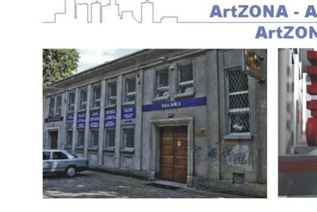
The objective of the ArtZONA pilot project activities is to revitalize a post-industrial building which was originally a garage bulit in the fifties of the twentieth century. The space is currently used for dance-related activities, but as its conditions does not meet contemporary standards, it is limited to only that one type of activity. Because of the lack of functionality and the longtime underinvestment effects, the potential of the space is not fully exploited.
Activities
The ArtZONA pilot action started in April 2011 and will last until March 2014. This makes a duration of all together 36 months.
The main task carried out under the ReNewTown project will be the adaptation of the building which will be named ArtZONA. Until now, the first step was to do common brainstorming and answer following questions:
– What are the needs and ideas of young artists?
– What kind of support do they expect from cultural institutions?
Therefore, it is planned to bring as many creative people as possible into the project’s creation phase.
Results
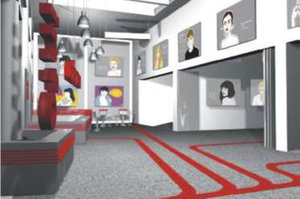
The outcome of the project will be a modern, open space with the potential to hold various types of cultural activities, accessible to the local community, local institutions and organizations in Nowa Huta. In the course of the project’s activities, the current space will be adapted to functions such as a gallery, an artists’ meeting place, a space for performances, concerts and multimedia presentations and a place to be used to hold trade fairs for local entrepreneurs.
ADAPT2DC – Tele-medical services for eldery people to reduce health care costs in north-western Małopolska (PL)

The aim of the action was to provide a tele-medical service (tele-ECG) to examine the beneficiaries’ health condition, improve their life quality, and prevent further deterioration of health. The patients received tele-medical equipment to measure ECG at home, and were provided medical assistance, consultation, and diagnosis both on a remote basis and in person. The action consisted of tele-ECK service provided to a group of 100 patients over 55 years of age. Tele-ECG kits were lent to the patients free of charge, for a period of 1 month. Every patient was instructed on how to operate the kit at home, office etc. In addition, the patients completed a life-quality survey. Subsequently, they were asked to perform at least 3 registrations a day and advised to record as many ECG events as needed. Moreover, patients were offered consultations by a dietician at the beginning and at the end of the examination period. After the examination period each patient received diagnosis, conclusions and recommendations made by the assigned physician in charge and dietician.
The goals were:
• Better access to health care in depopulating areas
• Decreasing costs of high quality health care
/by using the advantages of the new technologies (direct costs)
/by early diagnosis and preventing further deterioration of health (alternative costs)
• High quality medical service for elderly patients
• Reaching patients at risk of exclusion
Given the fact that almost all (97) participants completed the examination, it may be stated that there were no serious difficulties that could prevent or put off some people from participation.
Overall, the Małopolska pilot action has succeeded as a pioneering effort to bring technology closer to the aging society and overcome difficulties related to increasing health care costs in areas facing demographic changes.