
REGIONAL INFORMATION:
Wien / Austria
Area: 414,7 km²
GDP (PPS per inhabitant): 39.200
GDP Index EU 27: 165,9
Financial and business centre, Tourism, Financial services, R & D, Clusters, Tertiary sector, Food-processing industry, Construction industry

Vienna Region
If you are not yet a member you can register here.
| CENTROPE_TT | Tools for Transnational Innovation Support in Centrope | |
 |
Regional partner(s): | |
| INNOTRAIN IT | INNOvation TRAINing IT Central Europe | |
 |
Regional partner(s): |
|
| ET-struct | EconomicEducational Territorial – Structure | |
 |
Regional partner(s): |
|
| Re-Turn | Regions benefitting from returning migrants | |
 |
Regional partner(s): |
|
| i.e.SMART | SMART Training Network for Innovation and Entrepreneurship in Emerging Sustainable Economic Sectors | |
 |
Regional partner(s): |
|
| SoNorA | SOuth-NORth Axis | |
 |
Regional partner(s): | |
| BATCo | Baltic-Adriatic Transport Cooperation | |
 |
Regional partner(s): | |
| GUTS | Green Urban Transport Systems | |
 |
Regional partner(s): |
|
| EMPIRIC | Enhancing Multimodal Platforms, Inland waterways and Railways services Integration in Central Europe | |
 |
Regional partner(s): | |
| SPES | Support Patients through E-services Solutions | |
 |
Regional partner(s): | |
| RAILHUC | Railway Hub Cities and TEN-T network | |
 |
Regional partner(s): | |
| INWAPO | Upgrading of Inland Waterway and Sea Ports | |
 |
Regional partner(s): |
|
| EDITS | European Digital Traffic Infrastructure Network for Intelligent Transport Systems | |
 |
Regional partner(s): |
|
| TransEcoNet | Transnational Ecological Networks in Central Europe | |
 |
Regional partner(s): |
|
| 4BIOMASS | Fostering the sustainable usage of renewable energy sources in Central Europe – putting biomass into action | |
 |
Regional partner(s): | |
| LABEL | Adaptation to flood risk in the LABE-ELbe river basin | |
 |
Regional partner(s): |
|
| TransWaste | Formalisation of informal sector activities in collection and transboundary shipment of wastes in and to CEE | |
 |
Regional partner(s): | |
| URBAN-SMS | Urban Soil Management Strategy | |
 |
Regional partner(s): | |
| GOVERNEE | Good Governance in Energy Efficiency | |
 |
Regional partner(s): |
|
| CE-FRAME | Central European Flood Risk Assessment and Management in CENTROPE | |
 |
Regional partner(s): |
|
| INCA-CE | INCA Central Europe – Integrated nowcasting system for the Central European area | |
 |
Regional partner(s): |
|
| EnergyCity | Reducing energy consumption and CO2 emissions in cities across Central Europe | |
 |
Regional partner(s): |
|
| EULAKES | European Lakes Under Environmental Stressors (Supporting lake governance to mitigate the impact of climate change) | |
 |
Regional partner(s): | |
| HABIT-CHANGE | Adaptive management of climate-induced changes of habitat diversity in protected areas | |
 |
Regional partner(s): | |
| SEBE | Sustainable and Innovative European Biogas Environment | |
 |
Regional partner(s): | |
| TRANSENERGY | Transboundary Geothermal Energy Resources of Slovenia, Austria, Hungary and Slovakia | |
 |
Regional partner(s): |
|
| VITAL LANDSCAPES | Valorisation and Sustainable Development of Cultural Landscapes using Innovative Participation and Visualisation Techniques | |
 |
Regional partner(s): |
|
| GreenNet | Promoting the ecological network in the European Green Belt | |
 |
Regional partner(s): |
|
| UHI | Development and application of mitigation and adaptation strategies and measures for counteracting the global Urban Heat Islands phenomenon | |
 |
Regional partner(s): | |
| VIS NOVA | Sustainable and efficient Energy for Rural Regions | |
 |
Regional partner(s): |
|
| LISTEN TO THE VOICE OF VILLAGES | Local Initiative STrENgthening: how to build up a new TOurism in THE Valleys and among the mOst vItal CEntres OF rural VILLAGES | |
 |
Regional partner(s): | |
| Danube Limes – UNESCO World Heritage | Nomination of the Central European part of the Roman Danube Limes within the international UNESCO World Heritage Framework “Frontiers of the Roman Empire” | |
 |
Regional partner(s): |
|
| CENTROPE CAPACITY | Sustainable urban and regional cooperation for a polycentric territorial development in a competitive CENTROPE region | |
 |
Regional partner(s): | |
| UrbSpace | Urban spaces – enhancing the attractiveness and quality of the urban environment | |
 |
Regional partner(s): |
|
| CIRCUSE | Circular flow land use management | |
 |
Regional partner(s): | |
| CE-Ageing Platform | Central European Knowledge Platform for an Ageing Society | |
 |
Regional partner(s): | |
| Forte Cultura | Capitalising of fortified cultural heritage for sustainable development and competitiveness of cities and regions | |
| Regional partner(s): |
|
|
CENTROPE CAPACITY – Infrastructure Needs Assessment Tool – Fostering competitive regional development

Description
Ever since the beginning of intensified cross-border co-operation under the CENTROPE initiative, infrastructure and transport issues have played a key role. The notion of CENTROPE as a common, polycentric Euro region cannot stand without fast and capable transport links that allow for a high degree of economic integration as well as labour market mobility and workplace commuting. It is therefore all the more significant that the pilot action “Infrastructure Needs Assessment Tool” (INAT) was implemented within the project CENTROPE CAPACITY.
Strategy
As a first step, it produced a comprehensive overview on the state of transport infrastructure development in the quadrangle and a thorough analysis of shortcomings and future demands (INAT Mapping Report). Based on a common methodology, a transnational project team from all four countries accessed relevant documents and conducted a comprehensive mapping of existing regional development strategies, functional specificities as well as the infrastructure status quo. The “Strategic Framework for Transport and Infrastructure Development in centrope”, elaborated as a second step within this pilot action, represents the common answer of the partner regions and cities to the needs thus identified. Key analytical findings of the infrastructure assessment and on the content of the Strategic Framework for Transport and Infrastructure Development in centrope shall be described in the next paragraph.
Results
1. Main challenges:
- The dynamic integration of centrope will lead to a further increase of cross-border interactions, with a strong expected growth of car traffic unless the railway network is substantially upgraded andpublic transport services are improved
- Centrope as a transnational and European trafficand transport node will challenge infrastructurenetwork capacities as well as node facilities
- Serious bottlenecks and service deficiencies ofthe main infrastructure network are to be expected in the future
- Weak public transport supply is a threat for sustainable traffic and transport performance
- The responsibility for decision-making and budgets primarily lies with the national and European levels and calls for joint lobbying.
2. Findings of stakeholder assessment:
- Mobility improvement
- Business location development
- Spatial integration constituted major concerns for the comprehensive mapping of the infrastructure status quo that went along with a transnational stakeholder consultation process
Together, the findings of the assessment spell out major development potentials and challenges and lay bare the urgent need for a joint strategy.
3. Strategic Framework for future development
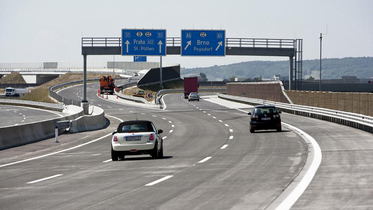
- A long-term “Vision 2030” for the main rail and road networks in centrope. It also contains a position on the revision of the Trans-European Transport Network (TEN-T), with an appeal to include important connections in the future Trans- European Core Network.
- Another main topic is the implementation and upgrading
of various regional cross-border connections. - The strategic development of the Danube as an important transport axis with several multimodal freight terminals and promising perspectives for passenger traffic is addressed as well, as is the further capacity enhancement of the centrope airport system.
- The gradual development of integrated crossborder public transport services will improve the mutual accessibility of the partner regions and cities by public transport.
- The implementation of a multimodal and multilingual traffic information system should create a user-friendly online service, with positive effects for an optimal utilisation of the existing infrastructure.
- The development of joint cross-border planning instruments is promoted, like a centrope traffic model, periodical surveys on cross-border traffic, a market analysis of cross-border public transport demand and periodical mobility surveys.
4. Results of Infrastructure Needs Assessment
- The dynamic integration of centrope leads to a growth in cross-border interactions
- Centrope as a transnational and European traffic and transport crossroads & node
- The main transport infrastructure requires upgrading to meet the requirements of the future
- The Danube offers untapped transport capacities
- An efficient airport system is crucial for the competitiveness of centrope
- Weak public transport supply threatens sustainable traffic and transport performance
- A growing region needs a join development strategy

Please, visit the CENTROPE website to download all detailed reports & statistical analysis of this pilot action.
INNOTRAIN IT – Integrating supply chain in the delivery process in Vienna (AT)
Company Background
The antiquated printing house in Austria (anonymous company), was bought by the owner and his wife in 1987. Innovations in new technologies started in the same year and continued in the coming years. In the 90th the division “media-creation” was started offering complete project management solutions – from conception to complex logistic. The move into the new eco-company-building was in the year 2001. In the following year the division “it-media” started with solutions for modern communication, marketing and organization assignments. The company’s efforts have been rewarded with numerous award and certificates, like the Austrian Environment Distinction (“Österreichisches Umweltzeichen”), the FSC Certificate and the Golden Pixel Award. In 2005, the company employed more than 50 employees, started a restructuration process and was also renamed, receiving its current name. 2006 an advertising agency was taken over. This was followed by five successful years in the different business areas. In 2008 company started the section film- and video-production.
Project Background
The company has grown strongly during the last years. At the same time it diversified its business activities towards more IT oriented ones. These had as a consequence that the IT department had to process a high number of user requests. Subsequently it ended doing mostly trouble shooting and not being able to follow the strategic focus set. The monitoring of the IT infrastructure and IT services took more and more time and became very complex. The four employees were overwhelmed, because they had no or just little support in the day-to-day business. Facing this type of problems the head of IT started to document himself with the topic of IT Management particularly with ITIL. He concluded that ITIL is too complex as a guideline for the company but started to implement only the ITSM processes which were considered interesting for the company – like a Service Desk and Problem Management. As the company culture is strongly oriented towards sustainability the IT department has also tried to implement and use environmentally friendly solutions.
Problem
The company addressed several challenges in order to optimize its business structures. A selection is presented below:
1. Optimizing the package labeling process:
The core business of the company is printing. The production process itself was already optimized technologically and from a human resource point of view. The delivery of products was done with external carriers. The process was looking like:
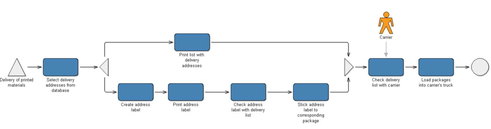
As the address labels were typed in manually – due to the system breach – and the carrier received a list, according to which the delivery was done this process was prone to:
- Long duration due to the need to manually create the addresses
- Mistakes due to eventual errors in printing the address labels
- Mistakes due to mismatches between the address label and the list
- Delivery mistakes of the carrier because of errors in the list.
These issues were all addressed in the solution approach.
2. Optimizing the response time to IT problems within the company:
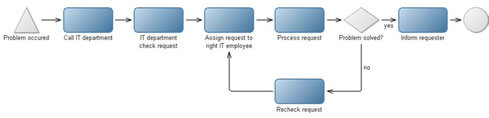
The problem with user request is that it is very hard for the IT employees to categorize and prioritize of the incoming requests. The requests have to be assigned to a specific IT employee with the necessary skills to handle the request. The coordination of the different requests and the assignment are complex processes and are difficult to resolve manually.
Approach
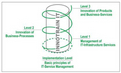
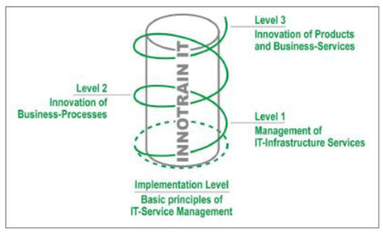
Each of the problems was addressed on a different level of the INNOTRAIN IT innovation spiral. While the “optimization of the delivery process” can be located on level 2 “Innovation of Business- Processes” the introduction of a Service Desk and well as ITIL-enabled processes like Problem and Incident Management corresponds to the implementation level, which deals with the “Basic Principles of IT-Service Management”. The introduction of hosting services is included in level 3 “Innovation of Products and Business-Services”.
1. Optimizing of the package labeling process:
Technological advance and the establishment of mobile devices in carrier companies made it possible to innovate on a business process level. The carrier company was offering a software solution with a standardized interface, which allowed the import of data sets for addresses and the automatic printing – including a bar code – of address labels. The bar code can then be read by the mobile device every truck driver is equipped with. Thus there the new process looks like this:

- Through the system integration – carrier system with the IT system of the company – several activities became redundant, thus shortening the overall process duration and costs.
- The most time consuming and cost intensive activity “Create address labels” was eliminated.
- The printing of lists has been completed eliminated, thus eliminating several sources of errors within the process.
2. Optimizing the response time to IT problems within the company
On the basis of the ITIL Service Desk the company defined and modeled a similar process. The IT department’s aim was to provide a single point of entry for all request and to facilitate the restoration of normal operation services with minimal business impact on the customers within agreed service levels and business priorities. Also in accordance to ITIL the Service Desk performs the following activities:
- Receive all calls and e-mails on incidents
- Record incidents
- Classify incidents
- Prioritize incidents
- Escalate incidents
- Search for Work Around
- Update the customer and the IT group on progress
- Perform communication activities for the other ITIL processes (e.g. SLM-reports, Change Management etc.)
- Perform daily CMDB verification
- Report to management and customers on Service Desk performance
Results & Innovation
Optimization of the package labeling process:
The introduction of a new software solution allowed the integration of previously disparate steps into one new innovative process, reducing costs and duration of a process with a high turnover rate. Capacities could be set free – in terms of personnel dealing with the process. The seamless integration of the carrier software into the own system allowed an improvement of the Supply Chain.
Introduction of a Service Desk and ITIL Selected Processes:
Novel is the introduction of a Service Desk. This is now the single point of entry in the IT-department. Through the service desk incident handling tasks and requests are dealt with as well as all the necessary communication. It also provides the interface for all other IT service processes, like change requests, maintenance contracts, service-level management, availability management, configuration management etc. All service desk activities are documented in a Ticketing System allowing the evaluation of activities.
Through the virtualization of the IT-infrastructure the responsible can access the system any time and from any place with a corresponding connection, thus being able to resolve urgent problems with high priority.
Furthermore the open source tool Nagios® has been implemented for IT Infrastructure Monitoring. This has been done as a precursory step for reporting activities which are considered for in the future. The IT-department strives to provide at the touch of a button IT-Service Management Reports providing customers with evaluations on e.g. Service Quality in the last reporting period. When deriving its goals from the IT strategy the department also coordinated the human resource development and qualification measures with the strategic goals. Using a gap analysis, the staff background and existing experience are mapped against desired qualification and corresponding courses/trainings are scheduled in order to achieve the desired status.
For further information on this pilot action please see the contact below:
Elena-Teodora Miron
University of Vienna
Faculty of Computer Science
Department of Knowledge and Business Engineering
Brünner Str. 72, 1210 Vienna, Austria
Phone: +43-14277-39582
E-Mail: innotrain(at)dke.univie.ac.at
or visit the project website: http://www.innotrain-it.eu/web/guest