REGIONAL INFORMATION:
Sachsen / Germany
Area: 18.415 km²
GDP (PPS per inhabitant): 22.620
GDP Index EU 27: 85,9
Automotive industry, Machinery, Textile industry, Micro technology, Tertiary sector, Mining, Energy industry, Tourism

If you are not yet a member you can register here.
| CERIM | Central Europe Research to Innovation Models | |
 |
Regional partner(s): | |
| PROINCOR | Proactive Innovation Support for SMEs in the Corridor from the Baltic to the Mediterranean Sea | |
 |
Regional partner(s): | |
| AutoNet | Transnational Network of Leading Automotive Regions in CE | |
 |
Regional partner(s): | |
| IDEA | Innovative Development of European Areas by Fostering Transnational Knowledge Development | |
 |
Regional partner(s): | |
| Re-Turn | Regions benefitting from returning migrants | |
 |
Regional partner(s): | |


| Via Regia + | Via Regia plus – Sustainable Mobility and Regional Cooperation along the Pan-European Transport Corridor III | |
 |
Regional partner(s): | |
| TROLLEY | TROLLEY – Promote Clean Public Transport | |
 |
Regional partner(s): | |
| FLAVIA | Freight and Logistics Advancement in Central Europe – Validation of processes, Improvements, Application of co-operation | |
 |
Regional partner(s): |
|
| INTER-Regio-Rail | Removing barriers to regional rail transport | |
 |
Regional partner(s): | |
| LOGICAL | Transnational LOGistics’ Improvement through Cloud computing and innovAtive cooperative business modeLs | |
 |
Regional partner(s): |
|
| Central MeetBike | More sustainable transport in Central European Cities through Improved integrated bicycle promotion and international networking | |
 |
Regional partner(s): | |
| RAILHUC | Railway Hub Cities and TEN-T network | |
 |
Regional partner(s): | |
| ESSENCE | Easy eServices to Shape and Empower SME Networks in Central Europe | |
 |
Regional partner(s): |
|
| REURIS | Revitalization of Urban River Spaces | |
 |
Regional partner(s): |
|
| TransEcoNet | Transnational Ecological Networks in Central Europe | |
 |
Regional partner(s): | |
| COACH BioEnergy | Strengthening the energetic use of biomass in Central and Eastern Europe by establishing a standardised transnational consulting net for regions | |
 |
Regional partner(s): | |
| LABEL | Adaptation to flood risk in the LABE-ELbe river basin | |
 |
Regional partner(s): | |
| TransWaste | Formalisation of informal sector activities in collection and transboundary shipment of wastes in and to CEE | |
 |
Regional partner(s): | |
| HABIT-CHANGE | Adaptive management of climate-induced changes of habitat diversity in protected areas | |
 |
Regional partner(s): | |
| SEBE | Sustainable and Innovative European Biogas Environment | |
 |
Regional partner(s): | |
| UFIREG | Ultrafine Particles – an evidence based contribution to the development of regional and European environmental and health policy | |
 |
Regional partner(s): |
|
| CoP | Cities on Power | |
 |
Regional partner(s): | |
| MANERGY | Paving the way for self-sufficient regional energy supply based on sustainable energy concepts and renewable energy sources | |
 |
Regional partner(s): | |
| VIS NOVA | Sustainable and efficient Energy for Rural Regions | |
 |
Regional partner(s): |
|
| ECOPAPERLOOP | Eco design for the enhancement of central Europe paper based products recycling loop | |
 |
Regional partner(s): |
|
| ReSOURCE | Utilisation of post-mining potentials for sustainable re-development in Central European mining cities and regions | |
 |
Regional partner(s): | |
| CIRCUSE | Circular flow land use management | |
 |
Regional partner(s): | |
| Creative Cities | Development and Promotion of Creative Industry Potentials in Central European Cities | |
 |
Regional partner(s): |
|
| QUALIST | Improving quality of life in small towns | |
 |
Regional partner(s): |
|
| SECOND CHANCE | From Industrial Use to Creative Impulse | |
 |
Regional partner(s): |
|
| EPOurban | Enabling Private Owners of Residential Buildings to Integrate them into Urban Restructuring Processes | |
 |
Regional partner(s): |
|
| CCC | Cultural Capital Counts | |
 |
Regional partner(s): | |
| ADAPT2DC | New innovative solutions to adapt governance and management of public infrastructure and services to demographic change in shrinking regions and cities of CE | |
 |
Regional partner(s): | |
| HELPS | Housing and Home-care for the Elderly and vulnerable people and Local Partnership Strategies in Central | |
 |
Regional partner(s): |
|
| THETRIS | THEmatic Transnational church Route development with the Involvement of local Society | |
 |
Regional partner(s): |
|
| SHIFT-X | Employing cultural heritage as promoter in the economic and social transition of old-industrial regions | |
 |
Regional partner(s): |
|
| CITY REGIONS | Increasing the competitiveness of city regions through integrated urban-rural development | |
 |
Regional partner(s): |
|
REURIS – Local rivers and canals in Leipzig, Saxony (GER)
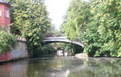
The Karl-Heine-Channel in Leipzig has high value as recreation area. Through revitalization activities and the opening of the channel for small boats as well as the creation of a foot and bicycle path at the waterside the quality of the area has further improved. Nevertheless due to insufficient artificial lightening the area is only attractive during day-light.
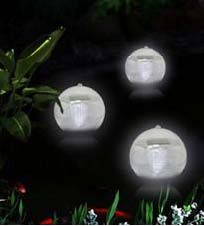
A concept worked out by the CENTRAL EUROPE project REURIS proposed different illuminations for the 15 bridges crossing the channel. A first temporarily illumination showed that attractiveness of the area has increased significantly through the colorful electric lightings, and brought added value not just for the recreation for inhabitants of Leipzig, but also for tourism and gastronomy. The concepts were tested on a temporarily basis so far, but also permanent illumination is possible for the future.
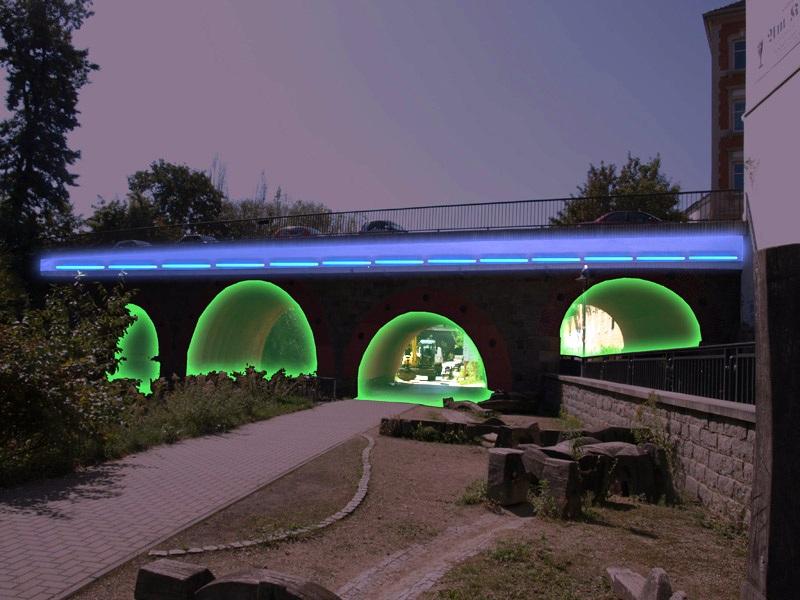
As the bridges crossing the channels are very diverse, reaching from street bridges made of concrete to wooden bicycle and foot bridges, also different concepts for each of the bridges were foreseen. Like blue and white balls illustrating an H2O molecule hanging below the bridge or swimming solar lamps or mirrors which are fixed blow the water surface.
SECOND CHANCE – Revitalization of Halle 14, Leipzig (De)
Background
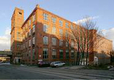
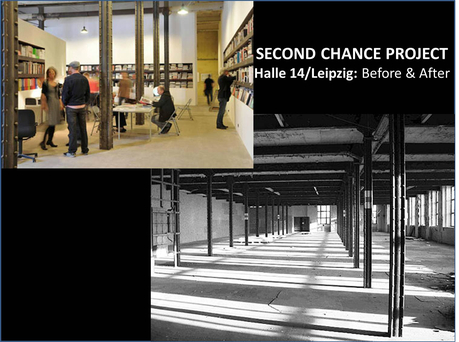
In the year 2002, ten years after the production in HALLE 14 was shut down, the Federkiel Foundation For Contemporary Art started using parts of the building for art installations, exhibitions and events. Since then the building has been dedicated to non-profit projects. For several years, the third floor of HALLE 14 was used as an exhibition space, however without restoration and only in the warm season due to the lack of heating. During that time, the other floors (each with a size of about 4.000 m2) were disused or temporarily used by artists.
Activities
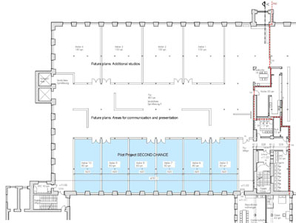
With the Second Chance project, HALLE 14 starts working with used zones after years of experimenting with large open spaces. To change the purpose of HALLE 14 into working places throughout the year, following activities occur:
- Cost- and energy-efficient wall constructions
- Insulation of the 2 x 4 m windows, the floor and the ceiling
- Efficient heating system and electric installation.
The pilot project will serve as a model for the other studios, the flats and other intensely used zones in the building.
Results
Since 2007, the development and renovation of HALLE 14 are dominant issues. Besides the restoration of roof and facade, which were completed in 2009, a visitor centre was built on the ground floor. In addition, about one third of the building are now renovated and developed for permanent use. Some of these spaces are used by HALLE 14 association for its various projects. Other spaces are used by the partners affiliated with HALLE 14 who cooperate for the joint purposes of the art centre. New projects to be set up in the still empty spaces are a residency programme for international artists and cooperation projects with international partner institutions. Therefore, ten artist studios will be build on the first floor of HALLE 14. In addition, the first floor of an adjoining building is used for two artists-in-resideny flats to provide working and boarding facilities. These purposes confront HALLE 14 with new requirements. But until now, the first six of these studios (80 sqm each) constitute the pilot project for SECOND CHANCE.
Future outlook
The residency programme and the cooperation projects will complete the non-profit profile of the art centre HALLE 14. The residency programme is designed to be independent and open for international visual artists. The selection of artists will be made by an external jury. In addition, international institutions (including the SECOND CHANCE project partners) are invited to cooperate with HALLE 14 to send artists to Leipzig. Within both residency programmes, the international artists will introduce their culture and artistic background during the events that accompany the residency programme (open studios, exhibitions, artist talks). They will themselves benefit from the exchange and the contacts to Leipzig artists and art professionals. Finally, the international exchange will generate new dimensions of cultural discourse and provide new input for everybody involved.
Visit the website www.halle14.org to learn more about it.
ReSOURCE – Master plan Aue in Saxony (De)
Description
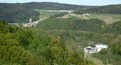
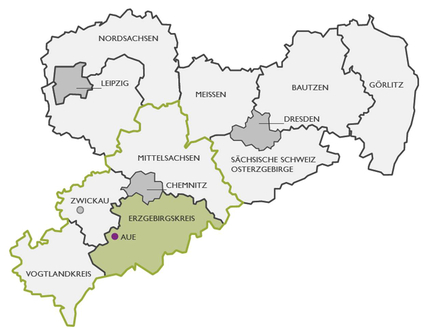
The town of Aue lies in the south west of the Free State of Saxony, within the Chemnitz- Zwickau conurbation in the relative vicinity of the two regional centres of Zwickau (25 km) and Chemnitz (35 km). Aue is a large regional town in the Saxon Erzgebirge district. Its location and transport links make the town of Aue a key link in the „Silberberg“ alliance of towns. The area for the sustainable subsequent use of the Wismut sites lies in the north of the town of Aue, between the river Zwickauer Mulde and the newly-constructed Chemnitzer Strasse (S255). The site covers an area of 380 ha. The extension from north to south totals approximately 5 km, from west to east approximately 2 km. The area of investigation of the former railway depot adjoins the Aue railway station site to the north.
Objectives of Master plan:
In further planning stages the highlighted potential is to be enhanced, deficits reduced and conflicts resolved. The goals and considerations of the existing plans are taken into account.
- Characteristic landscape
The historic development of the district of Alberoda can still be clearly seen in the structure of the plots and cultivated areas. Established as a forest village, long, narrow strip plots led from the farmstead across the fields and into the forest. In order to retain the mining history in the large-scale perception at least one of the heaps should be permanently recognisable in its geometric cubature.
- Ecological diversity & its future use
The woodlands will continue to be used for forestry purposes. Unforested areas are primarily earmarked for agricultural use. The recreation of a continual path system, including in the Wismut areas, is required for tourism use as a recreational area. Observation points should be created on summits and on the edges of slopes, individual areas established for specific usages. The establishment of cross links in the direction of Bad Schlema and the recreational facilities already located there is considered to be important. In the Mulde valley itself the objective is to create the cycle path in the vicinity of the water.
- Improved traffic links
Improved traffic links are a prerequisite for the future use of the site as an area of commerce, sport or recreation. For this reason, the area under consideration is firstly being extended.
Current plans that could be combined with one another here are:
– new link to the stadium, relocation of B169
– multi-storey car park on the S255/ B169
– development of commercial sites on the former freight yard
– new, barrier-free public transport interface (track only) at the station
- Car parking
A multi-storey car park for approximately 1,000 cars could be erected at the junction of S255/ B169. This would result in long-term easing of the situation during events at the football stadium.
- Use as Sportpark Aue
The use of the site as a sports park lends itself in particular in view of the connection to the stadium of the football club FC Erzgebirge Aue. The site offers space for up to four football pitches of 68 x 105 m in size. Various small pitches, a jogging and skating track (approx 1,400 m), a skating park in combination with a traffic training garden, a Kneipp facility on the Lößnitz stream and playgrounds further complement the range of possible uses. The sports fields can be positioned ideally on this large horizontal site. The construction of a three-pitch sports hall and the use of the manor as a training centre with guest house would be practical additions. This would enable the site to be transformed into a sports park that could be used by the football club, other clubs and schools. This approach would ideally satisfy the efforts of the sports clubs and the town of Aue to create optimal training conditions for various sports. This also reinforces the transformation of the reputation of the town of Aue from a formerly polluted industrial town to a sporting town with a future.
- Options for a state garden show
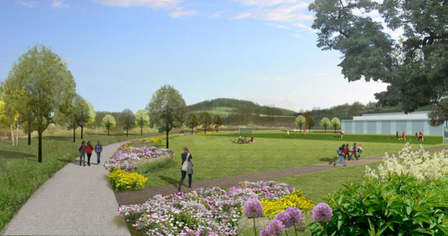
The motto for a garden show should ideally develop from the site itself. A theme that supports the future use as a sport and leisure area would be good from the point of view of the planners. „Sports fields and meadows“ are a thematic complex that has not been addressed as a key focus of previous garden shows. Transforming a site formerly used in association with mining and currently derelict into a blossoming place of sport, play and recreational enjoyment can be particularly inspirational here. The successes of the traditional football team WISMUT Aue are continued today with great commitment by FC Erzgebirge Aue. Here too, the post-mining scene is being redeveloped. A key element for the awarding of the state garden show to a site is the way in which the concept of subsequent use is viewed by the awarding party, the Free State of Saxony. The question of the sustainability of investment occupies a central position here. The advantages of a future sporting use have been detailed in the previous chapter.
Transnational value of this pilot action
This Masterplan can be taken as an example how a municipality like Aue can qualify the results of the mining period and turn them into a typical sign of this landscape. The risks emanating from the heaps have been eliminated by the restoration measures. The borderline in the future use of this post-mining regeneration landscape lies between sustainable reclamation, acknowledgement of the mining history in the form of the greened heaps and the careful development of flora and fauna in keeping with the prevailing conditions. In cooperation of all protagonists a higher level of regeneration quality can be achieved than specified in the restoration plans of the mining company, some of them older then 20 years. In this process new land uses like sport and tourism can be implemented. They are new sectors of economy with increasing importance. State garden shows or similar short time highlights are suited in a best way to develop sites that are neglected and underdeveloped for longer time. They force a sustainable positive development. The „turbo effect“ of such an event forces several developments in its surrounding and helps to concentrate the power in the region. An event like a State garden show can be seen as a milestone and catalyst in a long time development.