
REGIONAL INFORMATION:
Bayern / Germany
Area: 70.551,5 km²
GDP (PPS per inhabitant): 35.530
GDP Index EU 27: 135,6
Automotive and supporting machinery industry, Engineering, IT sector, Biotechnology, Aerospace, Mechatronics and medical technology, Tourism
If you are not yet a member you can register here.
| FLAME | Future Laboratory for the Diffusion and Application of Innovation in Materials Science and Engineering | |
 |
Regional partner(s): | |
| INTRAMED-C2C | Innovation transfer in the medical sector from clinics to companies | |
 |
Regional partner(s): |
|
| CENILS | Central European Network for knowledge based on Innovative Light Sources | |
 |
Regional partner(s): |
|

| COACH BioEnergy | Strengthening the energetic use of biomass in Central and Eastern Europe by establishing a standardised transnational consulting net for regions | |
 |
Regional partner(s): | |
| EnergyCity | Reducing energy consumption and CO2 emissions in cities across Central Europe | |
 |
Regional partner(s): | |
| INARMA | Integrated Approach to Flood Risk Management | |
 |
Regional partner(s): |
|
| GreenNet | Promoting the ecological network in the European Green Belt | |
 |
Regional partner(s): | |
| UFIREG | Ultrafine Particles – an evidence based contribution to the development of regional and European environmental and health policy | |
 |
Regional partner(s): | |
| CEP-REC | Introduction of Regional Energy Concepts | |
 |
Regional partner(s): |
|
| DANUBENERGY | Improving eco-efficiency of bio-energy production and supply in riparian areas of the Danube river basin and other floodplains in Central Europe – DANUBENERGY | |
 |
Regional partner(s): |
|

| CROSSCULTOUR | Cross Marketing Strategies for Culture and Tourism for more Attractiveness and Competitiveness for Cities and Regions | |
 |
Regional partner(s): | |
| LISTEN TO THE VOICE OF VILLAGES | Local Initiative STrENgthening: how to build up a new TOurism in THE Valleys and among the mOst vItal CEntres OF rural VILLAGES | |
 |
Regional partner(s): | |
| SECOND CHANCE | From Industrial Use to Creative Impulse | |
 |
Regional partner(s): |
|
| HERMAN | Management of Cultural Heritage in the Central Europe Area | |
 |
Regional partner(s): |
|
| Forte Cultura | Capitalising of fortified cultural heritage for sustainable development and competitiveness of cities and regions | |
| Regional partner(s): |
|
|
CEP-REC – Results of energy analysis in Allgäu (DE)

In addition to tourism and agriculture, mechanical engineering, automotive components and packaging industries thrive. To meet the demands of the future and to establish the region as a leader in optimal energy use, a common energy concept was devised.
Within the concept, developed under the name “Energy Future Allgäu” (Energiezukunft Allgäu), the present status of supply was analysed and a path towards a future energy system was developed. The first step was to start a campaign for energy efficiency in industry and enterprises across the whole region.
Solar energy has highest potential
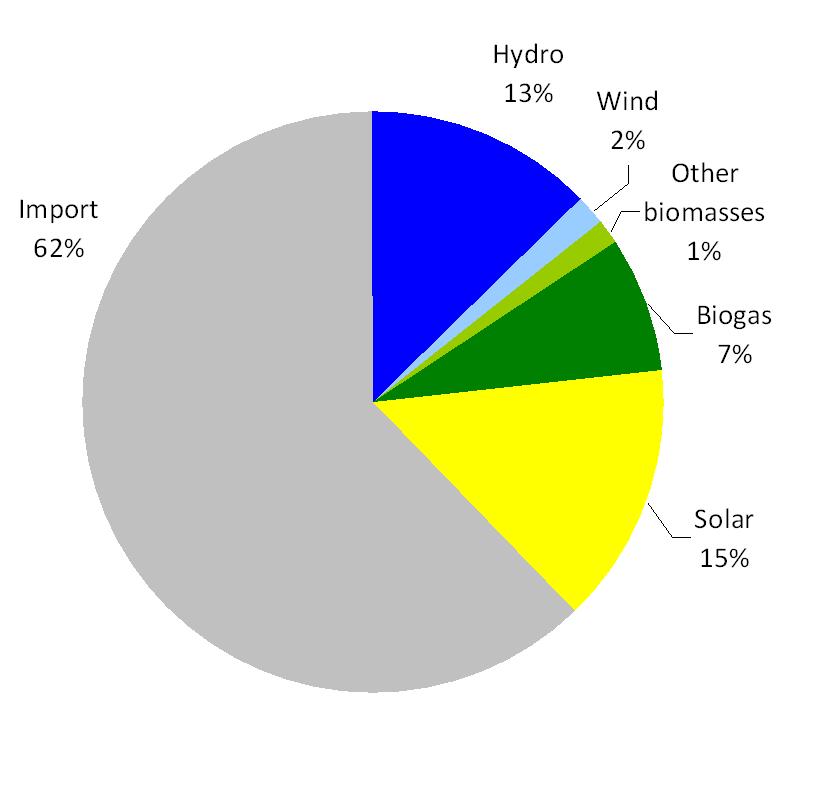
Electricity production by renewable emnrgies (2011)
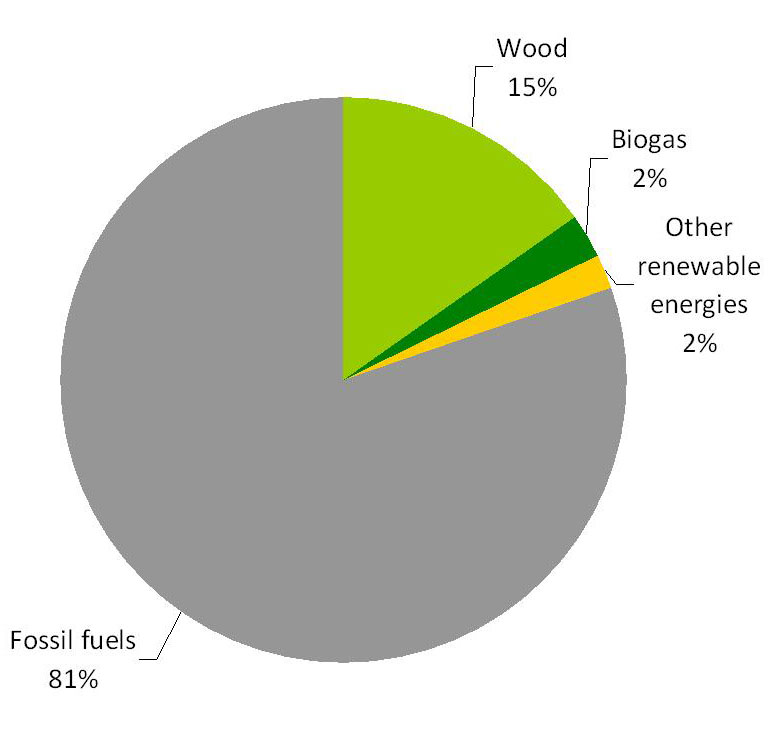
Heat production by renewable energies (2011)
In 2011 the total energy demand of the region, including that of the transportation sector, was 22.1 TWh. Although electricity is the energy carrier most usually discussed, its share of the total final energy demand was only 18 %.
There is great potential to increase on the current 38 % from renewables, based on data from 2011. Solar energy has the highest potential, followed by wind energy.
To satisfy demand in the heat sector, the main renewable energy source (RES) is wood. There is some potential to increase heating production from renewables with solar thermal energy, biogas and near surface geothermal energy, but it is limited. By comparison, the potential benefit through energy efficiency and energy savings is much greater
Contact:
eza! energy and environmental centre allgaeu
www.energiezukunft-allgaeu.info | www.eza.eu.
ADAPT2DC – Demography coaching in Thuringia and Bavaria (DE)
The specific measures were thus not pre-defined from the beginning, but instead the goal was to encourage a “bottom-up” process. The demography coaches in both regions offer their time and their expertise to manage and support the process of implementation of small-scale measures.
Saale-Orla-Kreis in Thuringia
After the consultation with relevant stakeholders, the demography coach identified three measures that can be reasonably implemented within the given timeframe: Firstly, the combination of passenger transport and goods transport is tested (“KombiBus”). Seeing that the public busses are only fully occupied during peak hours, the excess capacities can be used to transport packages and goods. This option would generate extra income for the bus company and thus ensure the long-term viability of the bus service. It would also allow local producers to transport their goods within the region at reasonable prices, without having to maintain their own logistics network. The regional bus company was willing to test the new concept. Before the start of the first bus line, two questions needed to be answered: whether legal obstacles exist, and if enough potential users exist to make the concept economically viable. For this purpose, two studies were initiated with the help of external experts. Both studies came to positive conclusions. Therefore the first testing round has currently started. The bus company also acquired the necessary transport boxes and hired a logistical disposition expert. Within the next months, the experiences from this initial phase shall be evaluated.
Secondly, a vacancy cadaster was developed with the help of GIS mapping software. This approach was tested in Remptendorf. The goal is to support the administration in marketing the vacancies in a targeted manner: For instance, potential buyers or investors can specifically be directed towards the vacancies in the town centre, avoiding the need for designating new development areas in the suburbs. Also other planning decisions can be made on a sound knowledge base. With the cadaster, it is now easier for the administration to evaluate whether a certain infrastructure will still attract sufficient users in the future, or whether downsizing has to be attempted.
Oberfranken-Ost in Bavaria
In Oberfranken, three specific measures were implemented with the support of the demography coach. In Arzberg, a model flat was equipped with “Ambient Assisted Living” Systems. These systems range from the central control of heating and lighting to the measurement of the resident’s blood pressure and pulse. The flat will be open for the public in regular intervals. The goal is to show how any flat can be easily equipped with affordable systems that enable elderly people to stay in their own homes for a longer time. The ultimate goal of these “AAL” systems is to delay the point when a person has to move to a care home. Thereby, the quality of life shall be improved but also costs in the care system shall be saved.
In Bad Berneck a vacancy cadaster was developed with the help of students in a geography course. The goal of the vacancy cadaster is to enable the targeted marketing of vacancies. Ultimately, the quality of life in the town shall be enhanced (by avoiding decaying buildings as much as possible).
In Hof, “integration guides” were trained in order to support those new residents who are not acquainted with bureaucratic requirements of the town. Volunteers signed up for the training course. The course was managed by the local “Volkshochschule” and touched upon issues like registration requirements, the German school system, or social activities for newcomers. The goal is to relieve both the administration and the new residents.
In Bad Berneck a vacancy cadaster is developed with the help of students in a geography course. The goal of the vacancy cadaster is to enable the targeted marketing of vacancies. Ultimately, the quality of life in the town shall be enhanced (by avoiding decaying buildings as much as possible).
In Hof, “integration guides” are trained in order to support those new residents who are not acquainted with bureaucratic requirements of the town. Volunteers can sign up for the training course. Already a number of volunteers have shown interest. The goal is to relieve both the administration and the new residents.