
REGIONAL INFORMATION:
Baden-Württemberg / Germany
Area: 35.752 km²
GDP (PPS per inhabitant): 33.800
GDP Index EU 27: 128,8
Machinenery, Automotive industry, Industrial technology, Light eneneering, Research and Development
If you are not yet a member you can register here.
| CERIM | Central Europe Research to Innovation Models | |
 |
Regional partner(s): |
|
| INNOTRAIN IT | INNOvation TRAINing IT Central Europe | |
 |
Regional partner(s): | |
| CEBBIS | Central Europe Branch Based Innovation Support | |
 |
Regional partner(s): | |
| ACCESS | ACCelerating regional competitivenESS and sector-based excellence through innovation management tools and techniques | |
 |
Regional partner(s): | |
| CLUSTERS-CORD | Clusters & Cooperation for Regional Development in Central Europe | |
 |
Regional partner(s): |
|
| CentraLab | Central European Living Lab for Territorial Innovation | |
 |
Regional partner(s): | |
| SMART FRAME | Smart Framework for SME´s focused on Modern Industrial Technologies | |
 |
Regional partner(s): | |
| FORT | Fostering continuous research and technology application | |
 |
Regional partner(s): | |
| CluStrat | Boosting innovation through new cluster concepts in support of emerging issues and cross-sectoral themes | |
 |
Regional partner(s): |
|
| i.e.SMART | SMART Training Network for Innovation and Entrepreneurship in Emerging Sustainable Economic Sectors | |
 |
Regional partner(s): |
|
| CentralCommunity | Emerging communities for collective innovation in Central Europe | |
 |
Regional partner(s): | |

| INTER-Regio-Rail | Removing barriers to regional rail transport | |
 |
Regional partner(s): | |

| REURIS | Revitalization of Urban River Spaces | |
 |
Regional partner(s): | |
| FOKS | Focus on Key Sources of Environmental Risks | |
 |
Regional partner(s): | |
| SALVERE | Semi-natural grassland as a source of biodiversity improvement | |
 |
Regional partner(s): | |
| URBAN-SMS | Urban Soil Management Strategy | |
 |
Regional partner(s): | |
| INCA-CE | INCA Central Europe – Integrated nowcasting system for the Central European area | |
 |
Regional partner(s): |
|
| EnergyCity | Reducing energy consumption and CO2 emissions in cities across Central Europe | |
 |
Regional partner(s): | |
| EnSURE | Energy Savings in Urban Quarters through Rehabilitation and New Ways of Energy Supply | |
 |
Regional partner(s): | |
| SEBE | Sustainable and Innovative European Biogas Environment | |
 |
Regional partner(s): | |
| UHI | Development and application of mitigation and adaptation strategies and measures for counteracting the global Urban Heat Islands phenomenon | |
 |
Regional partner(s): | |
| VIS NOVA | Sustainable and efficient Energy for Rural Regions | |
 |
Regional partner(s): |
|
| CEC5 | Demonstration of energy efficiency and utilisation of renewable energy sources through public buildings | |
 |
Regional partner(s): | |
| ECOPAPERLOOP | Eco design for the enhancement of central Europe paper based products recycling loop | |
 |
Regional partner(s): |
|
| DANUBENERGY | Improving eco-efficiency of bio-energy production and supply in riparian areas of the Danube river basin and other floodplains in Central Europe – DANUBENERGY | |
 |
Regional partner(s): |
|
| COBRAMAN | Manager Coordinating Brownfield Redevelopment Activities | |
 |
Regional partner(s): | |
| Q-AGEING | Quality Ageing in an Urban Environment | |
 |
Regional partner(s): | |

CEC5 – Demonstration building: Daycare facilities for primary school pupils in Ludwigsburg (DE)
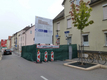
In the future all learning and care opportunities for primary school students will be combined in different buildings. Some buildings will be renovated in a sustainable way and others like the “Gartenstraße 14” will be constructed new.
The city council has already been taken the general decision to develop the primary school area including all different buildings.
The construction works of the demonstration building started in August 2013.
The conception of the future primary school area in the inner city of Ludwigsburg the demonstration building „Gartenstraße 14“ with all its functions is very important.
The building will include a cafeteria and a gymnasium. It will be used, on the one hand, by pupils of 2 primary schools and on the other hand, by local sport clubs. The design planning phase of the building and the technical equipment was finalized between October 2012 and April 2013. In April 2013 the tendering started. In the tendering different aspects were implemented to increase the sustainability of the building and to fulfill the requirements of CESBA. Moreover, a detailed planning of the exhibition concept is in progress. In addition the process of building a network in the field of sustainable energy assessment for public buildings is going on. For example there is a network and discussion with municipal energy managers, architects and institutes.