
REGIONAL INFORMATION:
Provincia Autonoma Trento / Italy
Area: 6.207 km²
GDP (PPS per inhabitant): 28.700
GDP Index EU 27: 121,5
Extraction and processing of non-metalliferous minerals: porphyry, Mechanics, Wood and Paper processing, Food processing, Tourism

If you are not yet a member you can register here.
| I3SME | INTRODUCING INNOVATION INSIDE SMEs | |
 |
Regional partner(s): | |
| CentraLab | Central European Living Lab for Territorial Innovation | |
 |
Regional partner(s): | |
| EULAKES | European Lakes Under Environmental Stressors (Supporting lake governance to mitigate the impact of climate change) | |
 |
Regional partner(s): |
|
| CEEM | Central Environmental and Energy Management as a kit for survival | |
 |
Regional partner(s): |
|
| LISTEN TO THE VOICE OF VILLAGES | Local Initiative STrENgthening: how to build up a new TOurism in THE Valleys and among the mOst vItal CEntres OF rural VILLAGES | |
 |
Regional partner(s): |
|
LISTEN TO THE VOICE OF VILLAGES – Rural atmosphere in Valle del Chiese (IT)
DESCRIPTION:
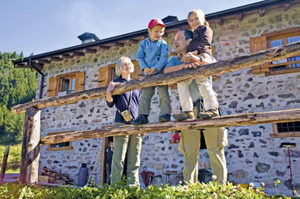
We are in Valle del Chiese, Trentino, where visitors are able to get in touch with an authentic rural atmosphere and unspoiled natural environment. Experiential workshops offered to guests are a unique opportunity to learn the old traditions of the valley and become the actors of this experience. Rio Caino awaits you with an original old forge and its blacksmith, and the old mill powered only by the water. The Rural Experience includes accommodation in a farm or traditional Bed & Breakfast, participation to excursions, and itineraries to discover the hidden part of Valle del Chiese and active involvement in experiential workshops. These new activities also highlight the value of rural traditions and show where natural and cultural landscapes meet.
ACTIVITIES:
1.) Local Guide Group (LGG) Meetings
In Valle del Chiese there are many different tourist initiatives: Some are developed by the Ecomuseum, others are planned by the Nature Park and some events are organised by the local Destination Management Organisation (DMO). This is the reason why the first main challenge of LGG has been the choice of a common subject which will become the basis of the new tourism strategy of this area. For the definition of the new pilot activity, the LGG involved representatives from two important museums in Trentino: the Natural Science Museum and the Ethnographic Museum. This collaboration was received positively by the LGG and gave higher value to the pilot activities, enhanced the local knowhow and brought visibility to the territory. The LGG of the Valle del Chiese meet more than 15 times with other project partners and participated in two Study Visits that were important to the implementation of pilot activities.
2.) Training courses
Training courses were held by the Trentino School of Management for the LGG members turned out to be of great importance concerning the definition of the pilot activities. Different themes were realised during the training phase, whereas some of the topics discussed were: Welcoming visitors, promoting local resources, and valorising culture and traditions. The most important concept for creative tourism development is the fact that the tourist is not a simple spectator, but becomes the main actor of the experience. Another important components of local tourism analysis are creating links between different economic sectors, mapping territorial resources, designing tourism products, communication and web marketing. The training courses helped participants to realise their ideas for creating real tourism products with a sustainable perspective related to local growth and the creation of a more shared vision of development.
3.) Experiental Workshops
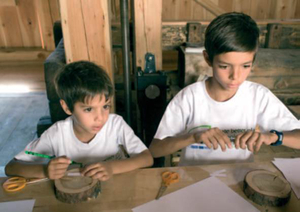
The implementation of experiential workshops give participants the opportunity to discover the environment, culture, and people living in the valley. This is in particular the promotion of the ethnographic path of Rio Caino, a path where tourists can visit old mils, a traditional forge, offi cinal gardens as well as where some experiential workshops like “Making bread in the traditional way” take place. The concept of these new workshops is to “travel like a local”, meaning initiatives linked with traditions where the participants became the protagonists of their experiences. LGG decided to create educational programmes and workshops for families (during the summer) but also for schools (in autumn and spring). For the development of these workshops, the LGG collaborated with two important museums of the Trento province: Museo degli Usi e Costumi della Gente Trentina and the Natural Science Museum. Another workshop for example named “The Tree Tells” is linked to the local tradition of wood. It aims to convey some ancient knowledge and traditions about wood to children and families. In summer 2011 this new experiential workshopwas tested and counted more than 150 participants during a two special day event.
4.) Innovative touch-sceen platform
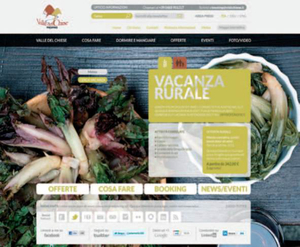
Another important output is the implementation of a new communication platform which promotes all the experiential activities offered by the territory. This tool provides the opportunity to immediately become the protagonist of initiatives: It is possible to post videos, to share pictures or to write comments. The touch-screen was placed on a glass wall of a local DMO, but the content could also be seen on DMO’s web site. It will be updated weekly with new content, feedback and input from social media platforms.
5.) Events
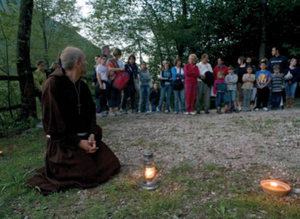
This pilot action also scheduled the organisation of different summer events in which the Rural Experience project was launched and experiential activities were offered to tourists. The events were scheduled at Rio Caino and were divided in two main parts. During the afternoon it was possible to participate in cultural events and creative workshops or in other guided tours in the territory, while during the evening Rio Caino turned into an outdoor theatre where a group of professional actors played live performances on the legend of Fra Dolcino, who spent part of his life in Valle del Chiese. During the evening show there was a local guide who gave information about history and traditions between the scenes. The events were a good opportunity not only to test the tourism products, but also to better involve the private stakeholders such as local restaurant owners.
RESULTS:
1.) Long-term governance asset
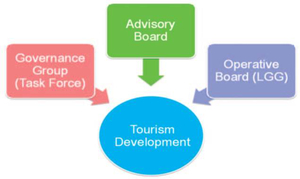
The main result of the "Rural Experience" pilot action was the establishment of a new governance model in this area. The Listen Local Guide Group and Task Force were turned into a permanent management asset with the creation of a Governance Task Force formed by the presidents of Ecomuseum, Tourism Board, and BIM Consortium as well as an Advisory Board which represents the area’s main stakeholders. The Tourism Board and Ecomuseum are now working on management and product development in close cooperation with the accommodation providers of the area.
2.) Participation of private stakeholders
The project established a basis of communication with the local accommodation owners. Many hotel owners participate in the Rural Experience product development project, contributing with an annual fee and working actively on product contents.
3.) Marketing Plan
“Rural Experience” represents a product development strategy brought together the local DMO and the Ecomuseum to work on a new marketing plan for this specific destination and the engagement of a new director of the Tourism Board. The Governance Task Force defined three cluster products (rural, family and active holiday) and a specific target for each one of them. A new communication plan was designed towards the new product development strategy which tried to focus on specific markets and clusters. The presentation of the marketing plan took place in November 2011.
4.) Sustainability
Finally, an important aspect which characterises the pilot action is the attention given to the sustainability of all actions. The choice of a bottom-up approach in the definition of pilot activities is a clear indicator of sustainability. All accommodations are family-run which gives a better overview of waste production, energy consumption, etc. as well as strengthen the economic cooperation among local tourism operators. Farm stays and agrotourism give the chance to experience real Italian hospitality and cuisine, to meet new people, not just as a tourist, but as a friend. Hereby, most of the promotion is done by Internet and e-mail marketing.
EULAKES – Assessment of the anthropogenic impact on Charzykowskie Lake (PL)
Location & lake characteristics
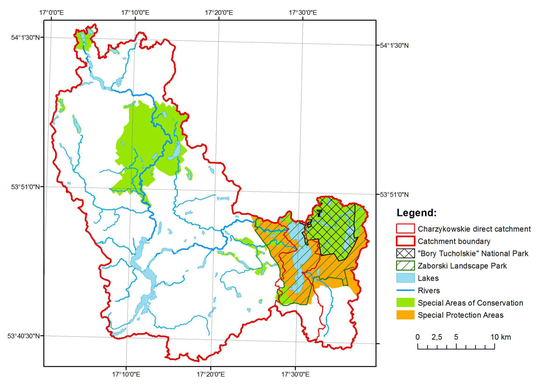
Lake Charzykowskie is located in the macro region of South Pomeranian Lake District, within the western part of Tuchola Forest and within the area of Zaborski Landscape Park; it touches the western limit of Tuchola Forest National Park. Since June 2010 it belongs to a buffer zone of Tuchola Forest Biosphere Reserve (MAB-UNESCO). It represents an abiotic type 3a and has been classified as a European whitefish type.
Description of Activities
The objective of the pilot action performed is to assess the anthropogenic impact on the Charzykowskie Lake. It was concluded that the influence is irregular and depends on the type and degree of the impact on the littoral zone, shape of the basin and water quality of tributaries. Measurements will be carried out in 3 deepest waters and 10 transects in littoral zone that represent different lake areas and various degree of impacts on the littoral zone. Transects will undergo monitoring for biotic elements (benthos, macrophytes) and abiotic elements (bottom material, water). Particular attention will be devoted to bottom sediments that form as a result of local biological production, and the inflow of allochthonous substance from the atmosphere and basin. We have observed sedimentation, accumulation and liberation processes of substances from sediments.
Deposited sediments consist of elements that are conductive to eutrophication i.e. nitrogen, phosphorus as well as harmful substances, pesticides and its metabolities as well as heavy metals. Sediments that line the basin have an important role in water exchange between the lake and groundwaters. Therefore, it is important to determine the insulating properties of the sediment. The study of bottom sediments will consist of an analysis of sediments composition with particular focus on heavy metals and pesticides. The permeability degree of sediments will be assessed. During the first stage of work we focused on selecting transects. In order to do so we made a DTM of the basin that visualised the shape of the bottom. It was made on the basis of an archival 60 year old material.
Results
The pilot action obtained data on distribution and characteristics of the Charzykowskie Lake sediments from that period. The digitized dimensional images will serve as a background for interpreting the analysis results carried out within the project. In addition, we started work on identifying stressors impacting the Charzykowskie Lake. We have gathered archival materials on land development, water and wastewater management of the municipality of Chojnice and characteristics of major tributaries of the Charzykowskie Lake.
The results of measuring the anthropogenic impact on the Charzykowskie Lake refer to:
– Catchment land use
– Direct catchment management
– Sewage management
– Breeding farms
– Water quality of the Charzykowskie Lake tributaries
– Biogenic compounds balance
Click HERE (PDF 5,5 MB) to download the full study.