REGIONAL INFORMATION:
Niederösterreich / Austria
Area: 19.177,8 km²
GDP (PPS per inhabitant): 23.900
GDP Index EU 27: 101,4
Tourism, Agriculture, Clusters, Wood processing, Automotive industry, Construction industry, Winegrowing, Food-processing industry, Mechanical sector, Chemical industry

If you are not yet a member you can register here.
| CENTROPE_TT | Tools for Transnational Innovation Support in Centrope | |
 |
Regional partner(s): | |

| CE-FRAME | Central European Flood Risk Assessment and Management in CENTROPE | |
 |
Regional partner(s): | |
| INCA-CE | INCA Central Europe – Integrated nowcasting system for the Central European area | |
 |
Regional partner(s): | |
| SEBE | Sustainable and Innovative European Biogas Environment | |
 |
Regional partner(s): | |
| VIS NOVA | Sustainable and efficient Energy for Rural Regions | |
 |
Regional partner(s): |
|
| DANUBENERGY | Improving eco-efficiency of bio-energy production and supply in riparian areas of the Danube river basin and other floodplains in Central Europe – DANUBENERGY | |
 |
Regional partner(s): |
|
| LiCEA | Life Cycle based Energy Audit | |
 |
Regional partner(s): |
|
| CENTROPE CAPACITY | Sustainable urban and regional cooperation for a polycentric territorial development in a competitive CENTROPE region | |
 |
Regional partner(s): | |
| QUALIST | Improving quality of life in small towns | |
 |
Regional partner(s): |
|

SEBE – Conversion of Energiepark Bruck/Leitha (AT)
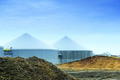
In recent years, electricity generation was the primary utilization path of biogas in Europe. This situation was mainly influenced by the existing supporting schemes (e.g. fixed feed-in tariffs for electricity). However, most biogas plants do not have a utilization path for the waste heat which is also produced by the combined heat and power unit (CHP). This is a huge economic and ecological problem.
On the contrary, a natural gas grid in the vicinity of a biogas plant offers a totally new utilization path for the produced biogas. Using adapted gas upgrading technology, biogas can easily upgrade to biomethane which then can be fed into the natural gas grid. This means biomethane can be stored and transported through the already existing infrastructure. It has no longer to be used on the site of the biogas plant. Furthermore, biomethane can be used for a variety of applications like heating purpose, electricity generation and also as vehicle fuel. Hence, biogas upgrading and grid injection is the most valuable option for this type of renewable energy.
ACTIVITIES
The biogas plant in Bruck/ Leitha generates electricity which is fed into the public electricity grid. The produced heat is fed into the local district heating grid which highly increases the overall efficiency. Nevertheless, as the biogas plant is located to a natural gas pipeline the operator wants to solely produce highly valuable biomethane. Therefore the entire biogas plant has to be adjusted to gas upgrading, which leads to certain legal and technical challenges:
1. First of all the technical and legal framework for a grid access has to be clarified. As the expected amounts of biomethane are way too much for the local natural gas grid during summer month it is necessary to build a high pressure compressor which enables the biomethane fed into the natural gas pipeline. Therefore costs and control tasks have to be clarified in cooperation with the legal grid operator
2. To meet the high quality requirements of the grid operator the biogas plant in “Bruck an der Leitha” wants to use a membrane technology. It is necessary to determine which upgrading method is suitable for the biogas plant Bruck.
3. At the moment the biogas plant produces the necessary electricity and process heat by itself. After conversion this is no longer possible. Therefore it is necessary to design a special heating concept for the whole plant. In this context the additional costs for heating should be reviewed via the biogas plant operator of Biogas Bruck/ Leitha.
RESULTS
A first draft of the study is finished. It shows that the feeding of upgraded biogas into natural gas networks is an option for enhanced use of renewable energy in our energy system. In contrast to use biogas at a combined heat and power station a high utilization of the fuel energy can be ensured as it is used as biomethane and fed into the grid. As the case study has shown many biogas plants are missing consumers for the produced co-generation heat. Therefore, by feeding Biogas into the gas grid the fuel will operate only for the actual useful energy. In Austria are, however, numerous legal and regulatory obstacles existing.
At a conversion process from an actual heat and electricity production to biomethane full upgrading system not only legal framework has to be considered but also technical data has to be observed meticulous. Elaborations to grid access, requirements to the gas upgrading technology as well as detailed information to a heating concept must be done. As every biogas plant has a specific local and regional framework each plant is individually predictable. A help for plant operators is provided through a check list which was elaborated during work on the pilot action.
Furthermore, the concept was presented on last Austrian national biogas conference. A lot of stakeholders, researchers and plant operators were addressed. A lot of feedback was given during the conference and the numerous attendances during the lectures reflects the fact that we are dealing with new discussions about the topic of new technologies at biogas plants.